The Records That Disagree Often Teach Us More Than the Ones That Don’t
By Gary Katz
Professional Genealogist & Genetic Genealogy Analyst
Most genealogy discoveries feel satisfying because they confirm something we already suspected.
The age matches.
The place fits.
The family relationships make sense.
Those moments naturally increase our confidence.
But experienced genealogists often become just as interested when a new record doesn’t fit.
Not because conflicting evidence is enjoyable…
But because it often reveals something the agreeing records cannot.
Agreement Builds Confidence
When multiple records point toward the same conclusion, confidence naturally grows.
Researchers may find:
- Dates that remain consistent across records
- Relationships that continue fitting the family structure
- Places that support expected migration patterns
- DNA evidence that reinforces the documentary record
Agreement matters.
It strengthens the explanation we’ve been building.
But agreement rarely forces us to think differently.
Conflicting Evidence Demands an Explanation
A conflicting record changes the investigation.
Instead of simply adding another piece of information, it raises an important question.
Why doesn’t this fit?
Experienced genealogists begin asking questions such as:
- Was the information recorded incorrectly?
- Could this be a different person?
- Is the timeline incomplete?
- Has a relationship been misunderstood?
- Does this record suggest an explanation I haven’t considered?
Those questions often become the most productive part of the investigation.
The Disagreement May Be the Clue
Many genealogy breakthroughs begin with one uncomfortable observation.
Perhaps:
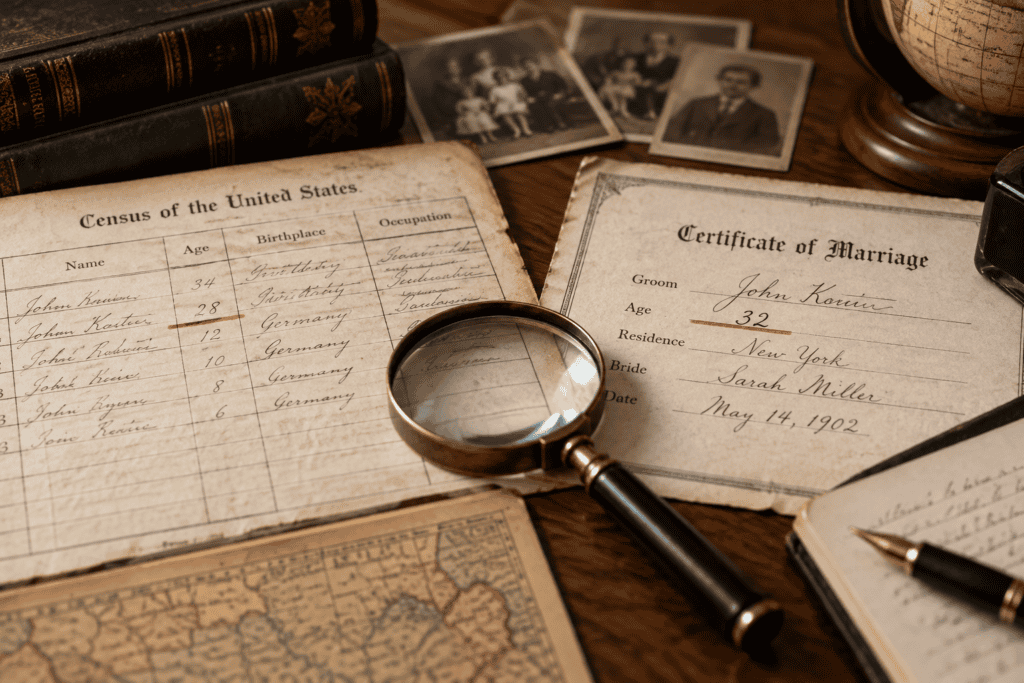
- A different age appears in one census
- A father’s given name changes between records
- A town of origin isn’t what previous documents suggested
- A surname is recorded in an unexpected way
At first, the conflict appears to weaken the conclusion.
Sometimes it does.
Other times, it exposes an assumption that had quietly gone unchallenged.
The disagreement becomes the clue that moves the research forward.
The Goal Isn’t Perfect Agreement
Historical records are created by people.
People make mistakes.
- Memories fade
- Clerks misunderstand
- Names change
Researchers quickly learn that complete agreement is uncommon.
The goal is not to force every record into harmony.
The goal is to understand why the records differ.
Sometimes the explanation is straightforward.
Sometimes it changes the entire direction of the investigation.
Either way, understanding improves.
What Genealogy Teaches About Disagreement
One of genealogy’s greatest lessons is that disagreement is not the enemy of understanding.
Unexplained agreement can create false confidence.
Carefully examined disagreement often produces deeper insight.
Experienced genealogists don’t ignore conflicting evidence.
They become curious about it.
Because the records that refuse to fit are sometimes the ones with the most important story to tell.
And that may be one of the most valuable habits genealogy has to offer.
Key Takeaways
- Agreement strengthens confidence, but conflicting evidence often leads to new understanding
- A conflicting record should invite investigation rather than immediate dismissal
- Historical records rarely agree perfectly, and differences are often informative
- The goal is to explain why records differ, not simply make them agree
- Some of the most important genealogy breakthroughs begin with evidence that doesn’t fit the existing explanation
About the Author
Gary Katz is a professional genealogist and DNA detective specializing in Jewish and Eastern European family research, DNA analysis, and lineage reconstruction. He writes about evidence, uncertainty, and decision-making through the lens of genealogy.
To follow Genealogy Gary’s ongoing work: