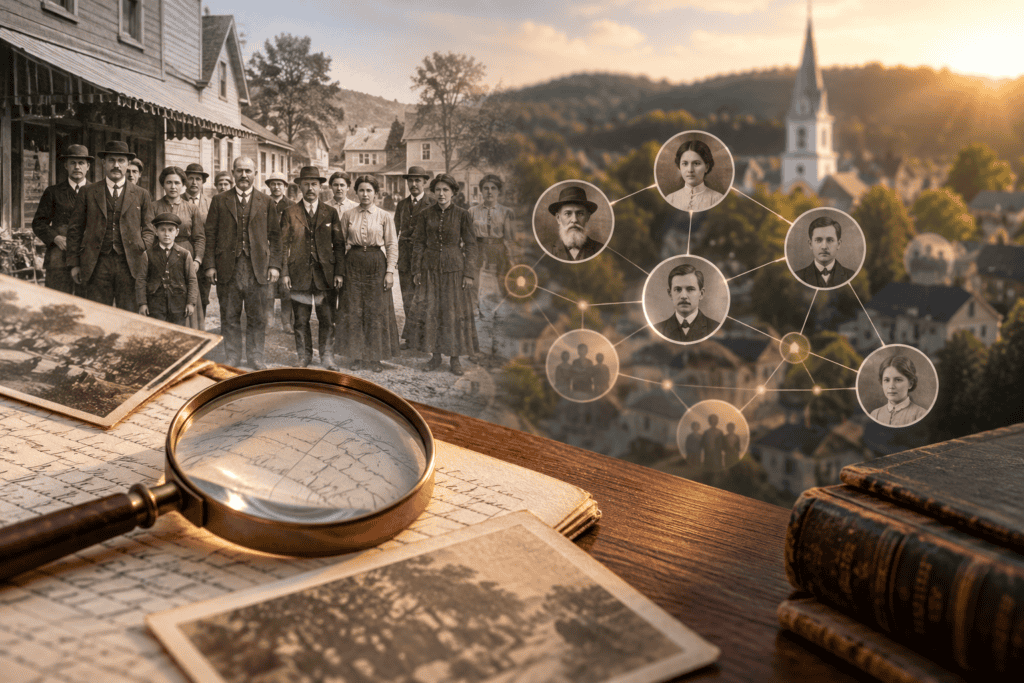
Ancestors Rarely Lived in Isolation . . . Their Communities Often Explain Their Choices
By Gary Katz
Professional Genealogist & Genetic Genealogy Analyst
Most genealogy begins with one person.
- An ancestor
- A birth record
- A marriage
- A census entry
It’s natural to focus our attention on that individual and the immediate family surrounding them.
Experienced genealogists eventually discover something important.
People rarely lived in isolation.
Their lives were shaped by the communities around them.
Sometimes understanding those communities explains far more than studying one individual ever could.
Every Family Belongs to a Community
Families don’t exist in a vacuum.
They live among other people.
They build relationships.
They participate in the life of their community.
That community may include:
- Neighbors
- Friends
- Coworkers
- Fellow congregants
- Business associates
- Local organizations
Those relationships leave traces throughout the historical record.
Researchers may notice:
- The same witnesses appearing at multiple weddings
- Neighbors who later immigrate together
- Families buried in the same cemetery section
- Business partners appearing in city directories
- Children from several families attending the same schools
- Congregations that connect people long before formal records do
Individually, these observations may seem ordinary.
Together, they reveal the community that shaped our ancestors’ lives.
Communities Explain Choices
One of the biggest shifts in genealogy happens when we stop asking only:
“Who was this person?”
and begin asking:
“Who surrounded this person?”
Communities often explain decisions that seem mysterious when viewed in isolation.
For example:
- Why did a family move to that town?
- Why did two unrelated families immigrate together?
- Why did the same surnames keep appearing as witnesses?
- Why did several households settle on the same street?
The answers often lie in the community rather than the individual.
The Story Is Bigger Than One Family
Over the years, I’ve found that researching the surrounding community frequently provides context I would never have discovered by focusing on one family alone.
As the community comes into focus, individual records begin making more sense.
Decisions that once seemed isolated become part of larger patterns involving:
- Migration
- Occupation
- Religious life
- Social networks
- Daily life
The investigation gradually shifts from reconstructing one family…
…to understanding the world that family inhabited.
That broader perspective often explains records that once seemed unrelated.
Communities Create Patterns
Communities shape far more than where people live.
They shape:
- Migration
- Marriage
- Occupations
- Religious affiliation
- Social networks
- Even the DNA matches we see today
What first appears to be a collection of unrelated records often turns out to be the story of one connected community.
Understanding those connections makes individual records far more meaningful.
What Genealogy Teaches About Community
One of genealogy’s greatest lessons is that people are rarely understood in isolation.
Every ancestor belonged to a larger network of:
- Family
- Friends
- Neighbors
- Coworkers
- Fellow community members
Those relationships shaped their:
- Opportunities
- Movements
- Decisions
- Lives
And ultimately, the records they left behind.
Experienced genealogists don’t simply reconstruct family trees.
They reconstruct communities.
Because sometimes the fastest way to understand one person…
…is to understand the community that helped shape their life.
Key Takeaways
- Ancestors are best understood within the communities in which they lived
- Neighbors, witnesses, coworkers, and fellow congregants often provide valuable historical context
- Communities frequently explain migration, marriage, occupation, and other life decisions
- Studying the surrounding community often reveals connections that individual records cannot
- Reconstructing a community can be just as important as reconstructing a family
About the Author
Gary Katz is a professional genealogist and DNA detective specializing in Jewish and Eastern European family research, DNA analysis, and lineage reconstruction. He writes about evidence, uncertainty, and decision-making through the lens of genealogy.
To follow Genealogy Gary’s ongoing work: