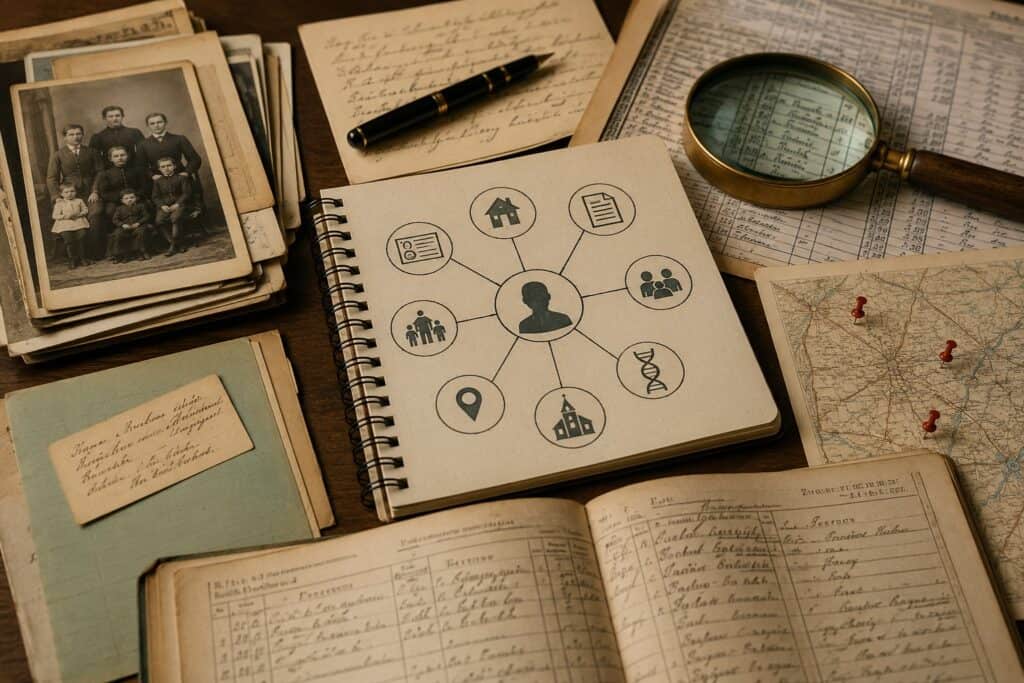
Individual Records Rarely Tell the Whole Story . . . Understanding Emerges When the Pieces Fit Together
By Gary Katz
Professional Genealogist & Genetic Genealogy Analyst
One of the most common misconceptions about genealogy is that the next record will provide the answer.
Sometimes it does.
More often, it provides another piece of a much larger puzzle.
For example:
- A census record may suggest a relationship.
- A birth record may support it.
- A probate record may raise new questions.
- DNA evidence may strengthen—or challenge—the emerging picture.
Individually, each source contributes information.
Together, they begin telling a story that no single record could reveal.
That process is known as evidence correlation.
It is one of the defining characteristics of thorough genealogy.
Records Gain Meaning in Relation to One Another
A single historical record rarely answers a complex genealogy question.
Researchers often work with information that is:
- Incomplete.
- Indirect.
- Conflicting.
- Open to more than one interpretation.
Viewed independently, each record has limitations.
Viewed together, patterns begin to emerge.
Those patterns often become more informative than the individual records themselves.
Correlation Is More Than Confirmation
It is easy to think of correlation as looking for records that agree.
In reality, correlation also involves recognizing where evidence does not agree.
Researchers compare:
- Dates.
- Places.
- Relationships.
- Ages.
- Occupations.
- Migration patterns.
- DNA evidence.
Agreement is informative.
Disagreement can be equally valuable.
Sometimes the contradiction is exactly what leads to a better explanation.
Every Record Changes the Context
One of the most interesting aspects of genealogy is that new evidence rarely stands alone.
Every additional record changes how earlier records are understood.
For example:
- A document that once appeared insignificant may suddenly become important.
- An assumption that once seemed reasonable may become difficult to defend.
- A relationship that appeared convincing may require reconsideration.
Correlation is an ongoing conversation among the evidence.
Strong Conclusions Grow From Connected Evidence
As researchers compare sources, several things begin happening.
Individual records become:
- Better understood.
- Better supported.
- Better explained.
At the same time:
- Weak assumptions become easier to recognize.
- Alternative explanations become easier to evaluate.
- Confidence becomes better calibrated to the available evidence.
This is why experienced genealogists spend so much time comparing records rather than simply collecting them.
What Genealogy Teaches About Understanding
One of the greatest lessons genealogy teaches is that understanding rarely comes from discovering a single remarkable record.
It comes from learning how many ordinary records relate to one another.
The answer is often found not in any one document, but in the relationships between them.
That is why genealogy is more than finding records.
It is learning how evidence works together.
And that may be one of the most valuable skills the discipline has to offer.
About the Author
Gary Katz is a professional genealogist and DNA detective specializing in Jewish and Eastern European family research, DNA analysis, and lineage reconstruction. He writes about evidence, uncertainty, and decision-making through the lens of genealogy.
To follow Genealogy Gary’s ongoing work: