In genealogy and beyond, incomplete information doesn’t just create uncertainty… it shapes how we interpret connection itself.
By Gary Katz
Professional Genealogist & Genetic Genealogy Analyst
I came across a post today that’s been sticking with me.
If you go back far enough… every person alive today is connected.
Mathematically… we’re all cousins.
That part is well established.
But what’s more interesting… at least from my perspective… is how difficult it is to actually demonstrate those connections in practice.
The Problem Isn’t Connection
In genealogy, the underlying reality is often connection.
Families intersect…
Lines converge…
Communities overlap…
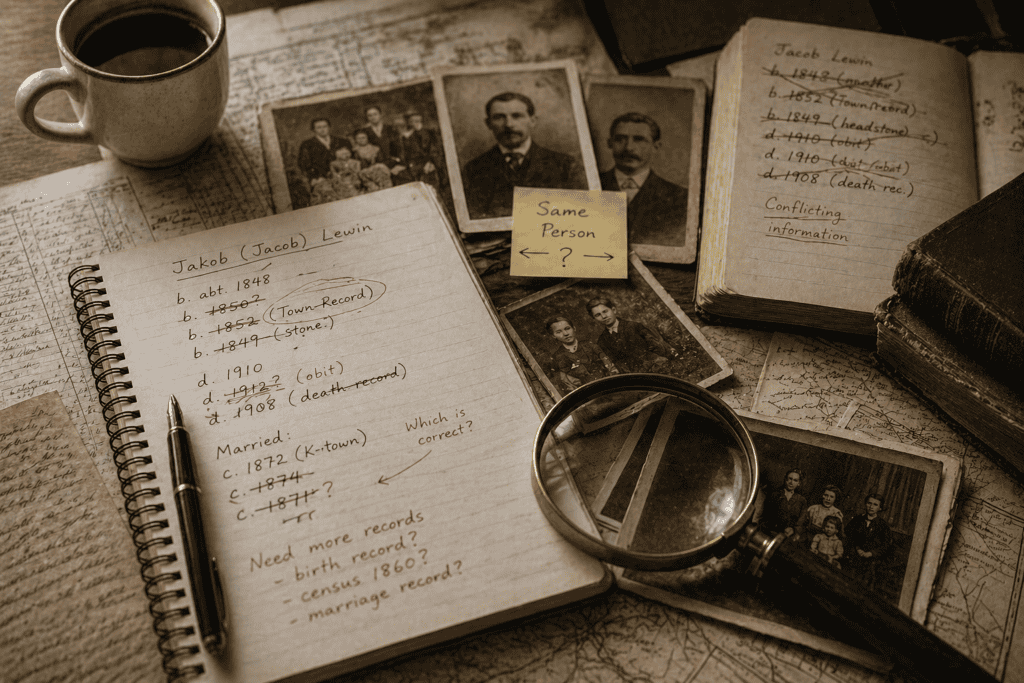
But the records that document those relationships are rarely complete.
- Records conflict
- Details are missing
- Timelines don’t fully align
So even when a connection is likely… or even highly probable… it can still feel uncertain.
What Happens in the Absence of Certainty
And in the absence of certainty… something else tends to happen.
We default to separation.
Not because the connection isn’t there…
but because we don’t have enough clarity to feel confident in it.
This is where the work really begins.
In genealogy, it means learning how to interpret incomplete information without overreaching… and without dismissing what might still be true.
The Shift From Collection to Interpretation
At a certain point, the task changes.
It moves from:
- Finding more information
To:
- Interpreting what is already available
That shift is not always obvious.
And it is not always comfortable.
- Weighing incomplete evidence
- Working with probabilities rather than certainty
- Holding conclusions with appropriate flexibility
The Risk of Filling the Gaps
When the evidence is partial… it creates a vacuum.
And that vacuum invites assumptions.
Sometimes those assumptions are reasonable.
But often, they are shaped by:
- What we expect to find
- What we hope is true
- What feels most coherent
And in many cases… those assumptions reinforce separation rather than connection.
A Broader Pattern
This dynamic is not limited to genealogy.
- The data is incomplete
- The signals are inconsistent
- A conclusion still has to be made
And in those situations… the same pattern appears.
When the evidence is unclear… people hesitate to accept what is likely… and default instead to what is certain.
Even if that certainty is misleading.
A Different Question
So the question becomes:
Not:
- Is the evidence complete?
But:
- Is the evidence sufficient to support a reasoned conclusion?
That distinction matters.
Because completeness is rare.
But sufficiency is often achievable.
Final Thought
Connection may exist… even when it cannot be fully demonstrated.
The challenge is learning how to work with that uncertainty…
Without overreaching…
and without dismissing what might still be true.
About the Author
Gary Katz is a professional genealogist and DNA detective specializing in Jewish and Eastern European family research, DNA analysis, and lineage reconstruction. He helps clients make sense of their ancestry and document their heritage.
If you’d like to follow along as I continue this work, I occasionally share notes and reflections in my
If you’re working through complex cases — especially those involving conflicting evidence or questions about how to interpret DNA results — the best place to begin is with a structured approach.
If you’re facing a difficult research question and want help clarifying what the evidence actually supports: