Strong Genealogy Is Not Defined by Never Changing Your Mind . . . It Is Defined by Knowing When the Evidence Justifies Doing So
By Gary Katz
Professional Genealogist & Genetic Genealogy Analyst
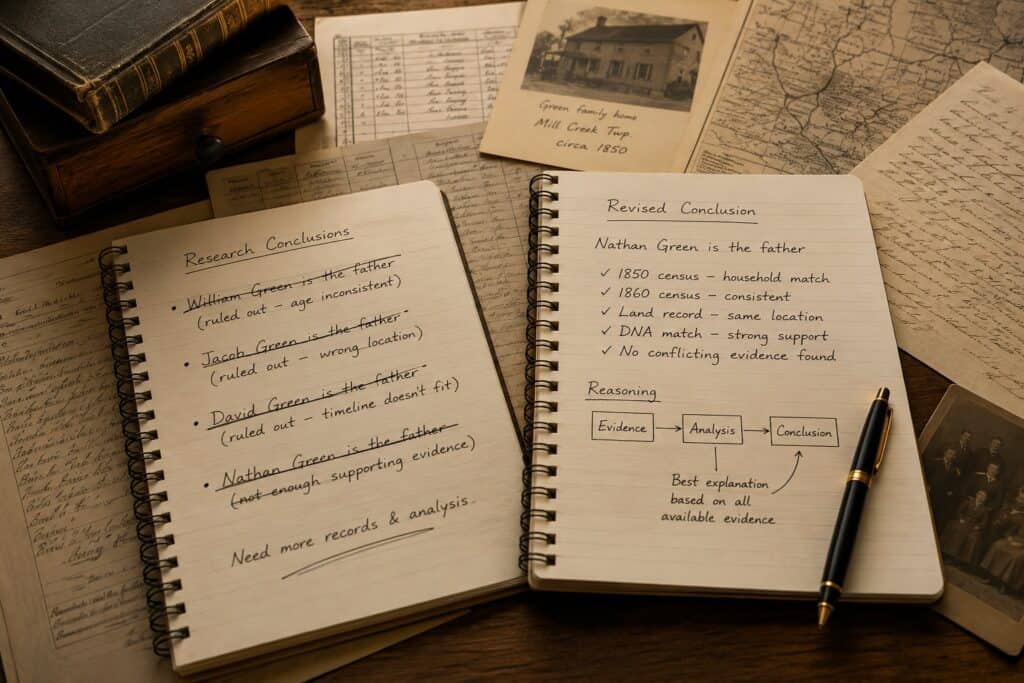
One of the biggest misconceptions in genealogy is that changing a conclusion means the original research was wrong.
Often, the opposite is true.
Revising a conclusion is one of the clearest signs that evidence-based research is working.
Genealogy is an ongoing process of discovery.
- New records appear.
- New DNA matches emerge.
- Old assumptions are questioned.
As the evidence changes, the most convincing explanation may change as well.
The goal is not to defend yesterday’s conclusion.
The goal is to follow today’s evidence.
Good Conclusions Are Built to Be Revisited
Every genealogy conclusion reflects the information available at a particular moment.
Some conclusions:
- Remain remarkably stable for years.
- Evolve as additional evidence becomes available.
Neither outcome should be surprising.
Good researchers understand that conclusions are not permanent.
They are the best explanations supported by the available evidence.
New Evidence Is Only One Reason
Researchers often assume a conclusion changes only when an important new record is discovered.
Sometimes that happens.
But conclusions also change when researchers:
- Reevaluate existing evidence.
- Recognize an overlooked assumption.
- Discover a stronger interpretation.
- Better understand the historical context.
- Reconsider competing explanations.
The evidence itself may not have changed.
The understanding of that evidence has.
Confidence Should Never End Curiosity
As conclusions become more convincing, confidence naturally increases.
That is healthy.
The danger comes when confidence begins replacing curiosity.
Experienced genealogists continue asking questions such as:
- Does the evidence still support this conclusion?
- Have I considered every reasonable explanation?
- Would I reach the same conclusion if I began the research today?
- Has new information changed the balance of evidence?
Those questions are not signs of doubt.
They are signs of disciplined thinking.
Changing Your Mind Is Not Starting Over
One reason researchers hesitate to revise conclusions is that it can feel like losing progress.
In reality, every conclusion contributes to the next stage of understanding.
Even a conclusion that later changes may have:
- Identified important records.
- Eliminated weaker explanations.
- Clarified the research question.
- Revealed where additional evidence was needed.
Good genealogy is cumulative.
Each conclusion—even one that is later revised—helps move the research forward.
Revision Strengthens Credibility
Some researchers worry that acknowledging a revised conclusion will weaken confidence in their work.
The opposite is usually true.
When genealogists openly explain why a conclusion changed, they demonstrate:
- Commitment to the evidence.
- Willingness to reconsider assumptions.
- Transparency in their reasoning.
- Confidence in the research process.
That kind of openness strengthens credibility.
Readers gain confidence because they can see that the conclusions follow the evidence—not the other way around.
Following the Evidence Wherever It Leads
Perhaps the greatest discipline genealogy teaches is the willingness to let evidence lead the investigation.
Sometimes the evidence:
- Confirms a long-held conclusion.
- Points somewhere entirely unexpected.
Both outcomes are valuable.
Because the purpose of genealogy is not to prove ourselves right.
It is to understand the past as accurately as the available evidence allows.
What Genealogy Teaches About Intellectual Flexibility
Over time, genealogy changes the way researchers think about changing their minds.
Revision is not:
- Failure.
- Weakness.
- An admission that previous work lacked value.
Instead, it reflects something much more important.
A commitment to following the evidence wherever it leads.
Because in genealogy, the strongest conclusions are not the ones that never change.
They are the ones that:
- Continue to evolve.
- Reflect new evidence.
- Better explain the available facts over time.
That is not a weakness in the research.
It is evidence that the research process is working exactly as it should.
About the Author
Gary Katz is a professional genealogist and DNA detective specializing in Jewish and Eastern European family research, DNA analysis, and lineage reconstruction. He writes about evidence, uncertainty, and decision-making through the lens of genealogy.
To follow Genealogy Gary’s ongoing work: