
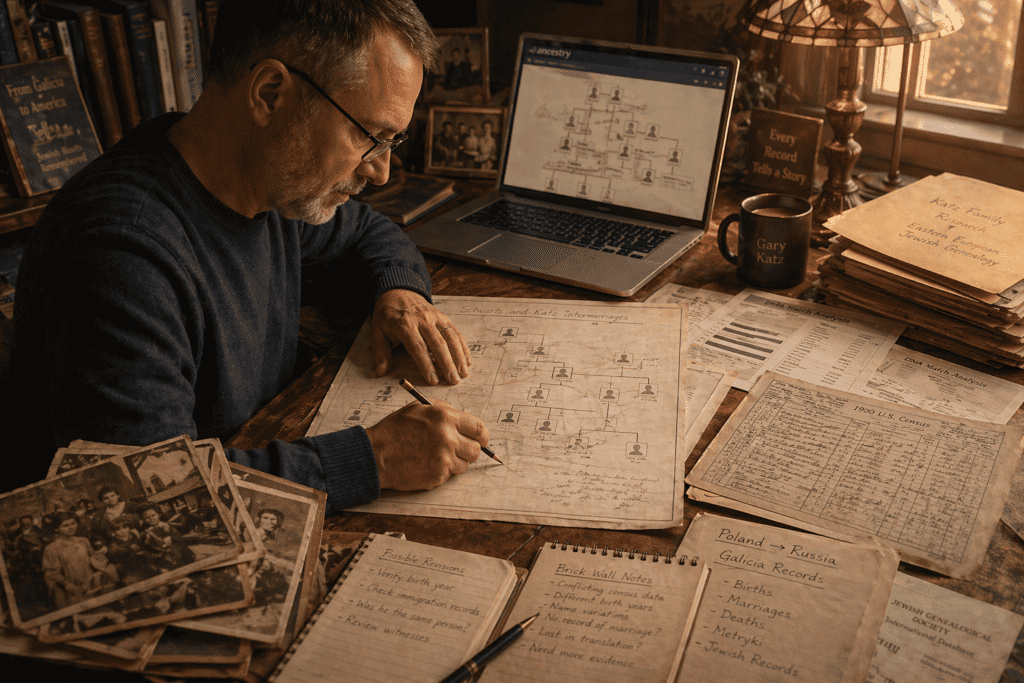
By Gary Katz
Professional Genealogist & Genetic Genealogy Analyst
A genealogy search does not end when a conclusion falls apart.
In many cases, that is where a different kind of work begins.
Once a conclusion no longer holds, a new question takes its place:
What comes next?
The Moment After the Shift
Most searches do not collapse all at once.
They shift.
- A contradiction appears
- A pattern fails to align
- A DNA signal introduces doubt
At first, the issue may seem small; something to resolve within the existing structure.
But sometimes the structure itself is the problem.
- The relationships depend on assumptions
- The timeline only works with adjustment
- The evidence supports more than one possibility
At that point, the search is no longer about extending a line.
It is about reconsidering it.
Why “Fixing” the Search Often Fails
The natural instinct is to repair what is already there.
- Adjust the timeline
- Reinterpret a record
- Find one more piece of confirming evidence
That approach has limits.
It keeps the original structure in place—even when that structure is the problem.
In practice, this often leads to:
- Increasingly complex explanations
- Greater reliance on assumptions
- A conclusion that becomes harder—not easier—to support
What looks like progress is often reinforcement.
What It Means to Rebuild a Search
Rebuilding is not the same as starting over.
It is a controlled reset.
The work does not disappear.
It changes status.
- Evidence becomes provisional
- Assumptions become explicit
- Conclusions return to hypothesis status
This shift matters.
It allows the existing research to be used without being constrained by it.
Where to Begin
A rebuild does not start with new records.
It starts with clarity.
- Separate what is known from what is inferred
- Identify the assumptions behind key relationships
- Isolate where the evidence becomes uncertain
- Define the question you are actually trying to answer
This creates a clean foundation.
Without it, new evidence is filtered through the same flawed structure.
Using Contradiction as a Guide
Once the structure loosens, contradiction becomes useful.
It is no longer something to resolve immediately.
It becomes something to follow.
- Which records no longer fit?
- Which matches do not align with the existing hypothesis?
- What alternative explanations could account for both?
These are not distractions.
They are direction.
What This Looks Like in Practice
Consider a search where the goal is to identify the parents of an immigrant ancestor.
This pattern appears frequently in DNA-supported research.
The paper trail appears consistent:
- The same surname appears across records
- The timeline aligns with known life events
- Census and immigration records point to a single place of origin
The conclusion feels stable.
Then DNA introduces a complication.
- A cluster of close matches shares a different surname
- Those matches trace back to a nearby—but distinct—community
- Expected matches from the documented line are limited or absent
At first, the instinct is to reconcile the discrepancy.
- Perhaps the matches connect through a collateral line
- Perhaps there is a recording error
- Perhaps more records will resolve the issue
But the pattern persists.
At that point, the question changes.
Not:
“How do these matches fit into the existing tree?”
But:
“What if the existing tree does not reflect the correct family?”
The search is then rebuilt around that possibility.
- The original conclusion is treated as a hypothesis
- The DNA cluster becomes a primary line of inquiry
- Alternative family structures are considered and tested
Progress resumes—but in a different direction.
A Second, Simpler Example
Consider a search based entirely on records.
Two men with the same name appear in the same region within a similar time frame.
At first, they are treated as the same individual.
The combined record set seems to support that conclusion:
- The age range is close
- The location is consistent
- The family structure appears to align
But small inconsistencies begin to accumulate.
- One record places him in a different occupation
- Another suggests a conflicting family member
- A timeline begins to require adjustment to hold together
Each issue can be explained.
Together, they suggest a different possibility:
Two individuals have been combined into one.
At that point, the search is rebuilt.
- The records are separated into distinct groups
- Each group is evaluated independently
- Competing identities are tested against the evidence
Clarity returns—not by adding more records, but by changing the structure.
Building Forward Again
A rebuilt search does not move in a straight line.
It moves through comparison.
- Different hypotheses are tested
- Evidence is evaluated against multiple possibilities
- Patterns are observed, not assumed
Over time, one explanation begins to account for more than the others.
Not because it is perfect.
Because it holds under pressure.
The Difference in the Work
At this stage, genealogy becomes less about collection . . .
And more about decision-making.
- What counts as evidence
- What remains uncertain
- Which explanation best fits what is known
These are judgment calls.
They determine the outcome of the search.
What This Means for Your Search
The point at which a genealogy search needs to be rebuilt can feel like a setback.
In practice, it is often where the most meaningful progress begins.
A stable—but untested—conclusion is replaced . . .
With a process designed to withstand being wrong.
About the Author
Gary Katz is a professional genealogist and DNA detective specializing in Jewish and Eastern European family research, DNA analysis, and lineage reconstruction. He helps clients make sense of their ancestry and document their heritage.
If you’d like to follow along as I continue this work, I occasionally share notes and reflections in my
If you’re working through complex cases — especially those involving conflicting evidence or questions about how to interpret DNA results — the best place to begin is with a structured approach.
If you’re facing a difficult research question and want help clarifying what the evidence actually supports: