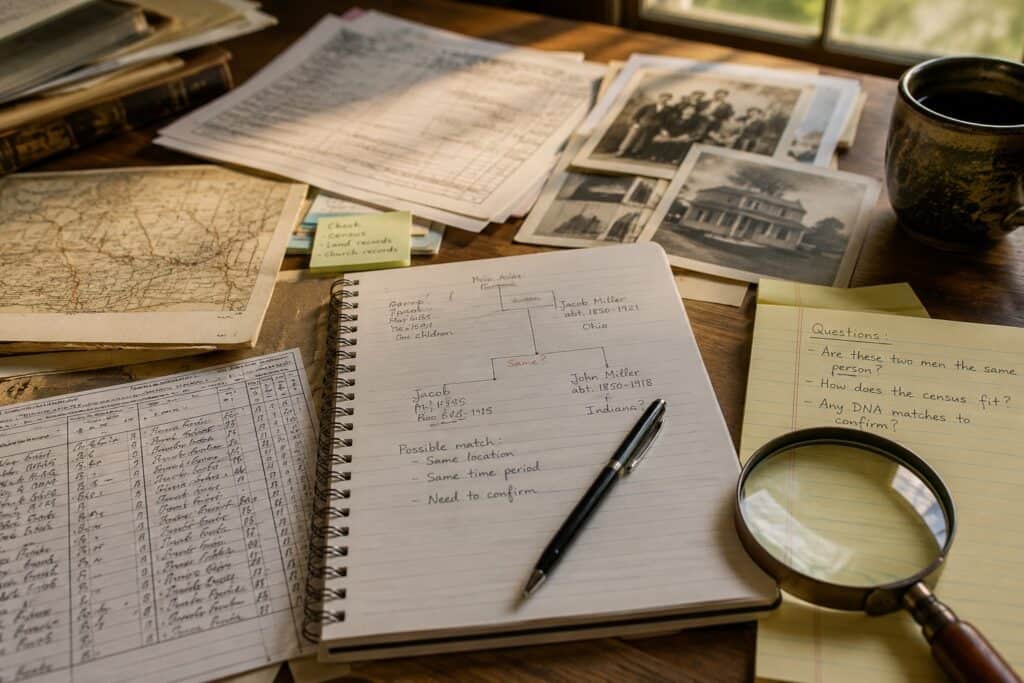
Some genealogy mistakes occur not because the evidence is weak . . . but because the conclusion seems stronger than it really is.
By Gary Katz
Professional Genealogist & Genetic Genealogy Analyst
One of the most uncomfortable moments in genealogy occurs when a conclusion falls apart.
Especially when it seemed well supported.
- The records were real.
- The timeline appeared coherent.
- Multiple pieces of evidence pointed in the same direction.
And yet, the conclusion turned out to be wrong.
That experience surprises many researchers.
Because it feels like strong evidence should naturally produce a correct conclusion.
But genealogy teaches a more complicated lesson.
Evidence and conclusions are not the same thing.
Why Strong Evidence Can Be Misleading
Most genealogy mistakes are not caused by fabricated records.
They are not caused by evidence that is obviously false.
More often, the evidence itself is real.
The challenge lies in determining what that evidence actually means.
- A document can be authentic.
- A relationship can be genuine.
- A timeline can be accurate.
And still, the broader conclusion can be mistaken.
Because evidence does not interpret itself.
Researchers must decide how individual pieces fit together.
That process always involves judgment.
When More Than One Explanation Fits
Many genealogy problems involve evidence that supports more than one possible explanation.
A census record may fit:
- one family structure
- or another
A DNA match may support:
- one relationship hypothesis
- or several
A migration pattern may appear convincing for:
- one individual
- or another person with a similar name
When only one explanation is considered, the evidence can appear stronger than it actually is.
But once competing explanations are examined, the situation often becomes less certain.
The evidence has not changed.
Only the interpretation has.
The Problem of Correct Records Attached to the Wrong Person
One of the most common genealogy errors involves attaching genuine records to the wrong individual.
This is especially common when:
- names repeat across generations
- relatives share similar identities
- multiple people lived in the same community
- records provide limited identifying details
The document itself may be entirely legitimate.
The mistake often occurs when:
- Multiple people share the same name.
- Generations repeat naming patterns.
- Records contain limited identifying information.
- Researchers stop testing alternative identities.
In those situations, the evidence is real.
The conclusion is what fails.
Why Confidence Can Become Dangerous
As evidence accumulates, confidence naturally increases.
That is not a problem.
Confidence is an important part of decision-making.
The difficulty arises when confidence begins reducing curiosity.
Researchers may start:
- Paying less attention to contradictory evidence.
- Overlooking alternative explanations.
- Interpreting ambiguous details more aggressively.
- Assuming the conclusion has already been established.
Over time, confidence can become self-reinforcing.
The conclusion starts shaping how new evidence is interpreted.
And that creates risk.
Not because the researcher lacks evidence.
But because the evidence is no longer being evaluated as critically.
How Genealogists Protect Themselves
Experienced genealogists often spend as much time testing conclusions as building them.
They ask questions such as:
- What else could explain these facts?
- Which assumptions support this conclusion?
- What evidence would contradict this interpretation?
- Have alternative explanations been considered seriously?
- Does the evidence support the conclusion, or merely allow it?
Those questions help reveal weaknesses that might otherwise remain hidden.
The goal is not skepticism for its own sake.
The goal is proportional confidence.
Why Revision Is Part of Good Genealogy
Many people assume revising a conclusion means something went wrong.
In reality, revision is often evidence that good genealogy is taking place.
New information continues to emerge:
- New records appear.
- New DNA matches emerge.
- Alternative explanations become visible.
- Previous assumptions are tested.
The strongest genealogists are not the ones who never change their conclusions.
They are the ones willing to reconsider them when the evidence requires it.
That willingness strengthens the search rather than weakening it.
What Genealogy Teaches About Reasoning
Over time, genealogy teaches that evidence alone is rarely enough.
- Records matter.
- Sources matter.
- Evidence matters.
But reasoning matters too.
Because evidence does not automatically produce conclusions.
Researchers do.
And some of the most important genealogy lessons emerge when strong evidence forces us to reconsider what we thought we already knew.
About the Author
Gary Katz is a professional genealogist and DNA detective specializing in Jewish and Eastern European family research, DNA analysis, and lineage reconstruction. He writes about evidence, uncertainty, and decision-making through the lens of genealogy.
Follow Genealogy Gary’s ongoing work: