The Most Valuable Clues Are Often Found Before and After the Record We Were Looking For
By Gary Katz
Professional Genealogist & Genetic Genealogy Analyst
Finding a long-sought genealogy record is one of the most satisfying moments in family history research.
After weeks — or sometimes years — of searching, the temptation is understandable.
- Find the record
- Extract the information
- Save it
- Move on
Experienced genealogists often do something very different.
They keep reading.
That’s because the discovery of one record frequently marks the beginning of the next stage of the investigation.
Every Record Has Neighbors
Historical records rarely exist in isolation.
They are usually part of a larger sequence.
That sequence may include :
- Earlier and later entries in the same register
- Consecutive certificate numbers
- Neighboring households in a census
- Adjacent land transactions
- Other families recorded by the same clerk
- Members of the same community appearing together
Each surrounding record has the potential to add context to the one we originally came to find.
Sometimes that context becomes more valuable than the original record itself.
The Records Around the Record
One of the habits I’ve developed over the years is rarely stopping with the page containing the target record.
Instead, I almost always examine the records immediately before and after it.
Sometimes I find nothing unexpected.
Other times, those surrounding entries reveal :
- Brothers and sisters recorded nearby
- Extended family members using similar surnames
- Friends serving as witnesses
- Entire neighborhoods or ethnic communities appearing together
- Patterns that would have been invisible had I looked at only one record
The record I was searching for answers one question.
The records around it often raise better ones.
Context Sometimes Lives on the Page
We often think of context as historical background.
But context can also be physical.
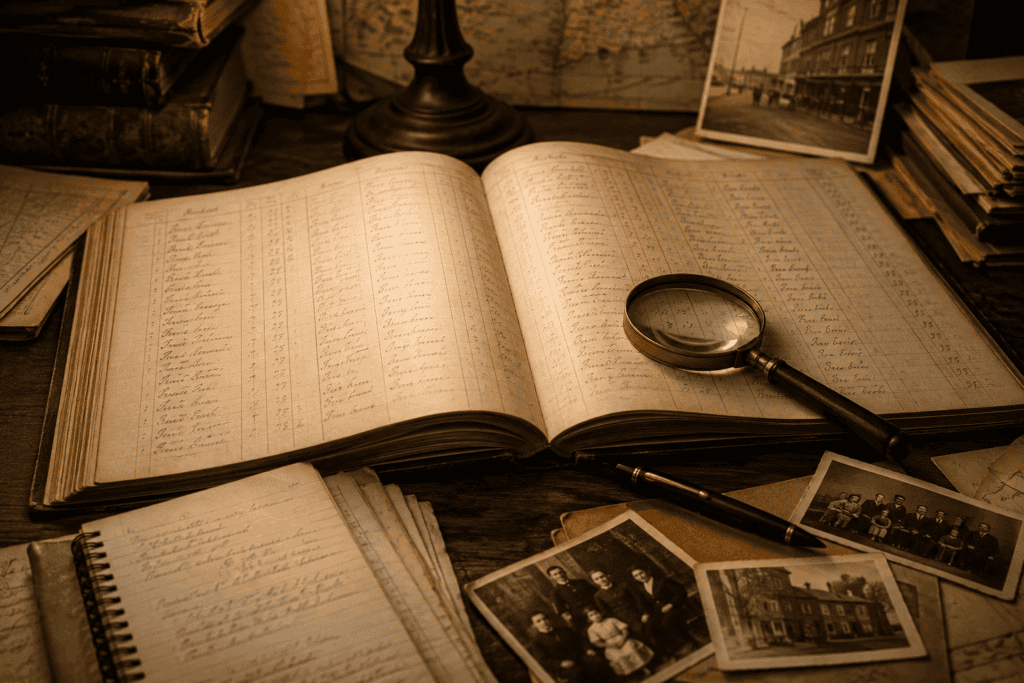
The position of a record within a ledger, register, or census can tell us something about how that record was created.
Researchers may discover :
- Families living next door to one another
- Groups immigrating together
- Clerks recording relatives sequentially
- Naming patterns that repeat across neighboring entries
- Communities that become visible only by reading beyond the target record
I’ve experienced this many times while researching New York City records.
What began as the search for one individual often expanded into the discovery of an entire section of a neighborhood populated by Jewish families whose records, viewed together, provided far more context than any single document could.
Sometimes the page tells a larger story than the individual record.
One Discovery Often Leads to the Next
One record frequently opens several new avenues of research.
It may identify :
- A previously unknown sibling
- An unexpected witness
- A nearby relative
- A familiar surname appearing again
- A new location to investigate
The search expands naturally.
The investigation becomes less about one document …
… and more about understanding the community in which that document belongs.
What Genealogy Teaches About Curiosity
One of genealogy’s greatest lessons is that discovery rarely ends with finding the record we were looking for.
Instead, each discovery invites us to ask another question.
- What came before it ?
- What followed it ?
- Who else appears nearby ?
Sometimes the answer we searched for is found in one record.
The understanding we gain comes from exploring the records around it.
And that may be one of the most valuable habits experienced genealogists develop.
Key Takeaways
- Finding one important record is often the beginning of the next stage of the investigation
- Historical records usually exist within larger sequences that provide valuable context
- Reading the records immediately before and after a target record can reveal relationships, communities, and patterns
- The physical arrangement of records often contributes to their interpretation
- Curiosity about the records surrounding a discovery frequently leads to the next breakthrough
About the Author
Gary Katz is a professional genealogist and DNA detective specializing in Jewish and Eastern European family research, DNA analysis, and lineage reconstruction. He writes about evidence, uncertainty, and decision-making through the lens of genealogy.
To follow Genealogy Gary’s ongoing work :