Names Identify People . . . Relationships Reveal Families
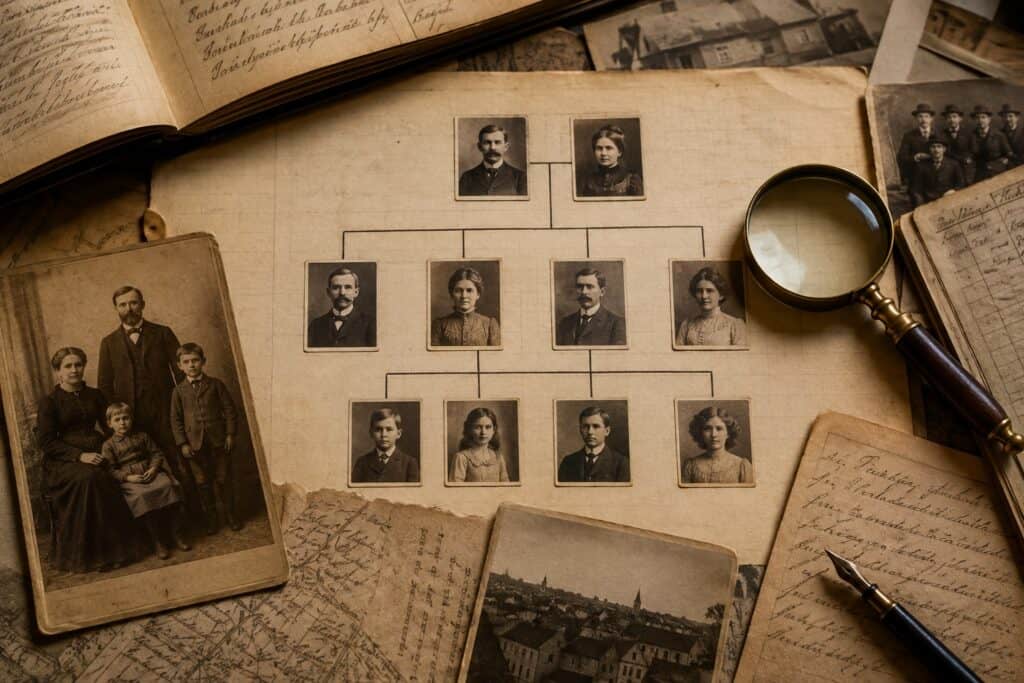
the relationships connecting them often reveal the family story.
By Gary Katz
Professional Genealogist & Genetic Genealogy Analyst
Most genealogy research begins with a name.
- A birth record
- A census
- A marriage certificate
- A passenger list
Those records introduce us to individuals.
But they rarely tell the whole story.
As genealogy research becomes more complex, researchers begin asking a different question.
Not simply:
“Who is this person?”
But:
“Who are the people surrounding this person?”
That shift often changes the entire investigation.
People Rarely Leave Records Alone
Historical records almost always place individuals within a larger network of relationships.
For example:
- A marriage record identifies witnesses
- A census places neighboring households side by side
- A probate file names heirs, executors, and guardians
- Immigration records reveal traveling companions
- Military records identify fellow soldiers
- DNA matches connect descendants of extended families
Each relationship provides additional context.
Individually, these people may appear incidental.
Collectively, they often become the key to understanding an ancestor’s identity.
Relationships Reveal Patterns
One isolated record may leave many questions unanswered.
Relationships begin revealing patterns.
For example:
- The same surname appears repeatedly among witnesses
- Neighboring households later migrate together
- Recurring occupations distinguish one family from another
- Multiple DNA matches descend from the same collateral line
- Relatives appear together across decades of historical records
Each observation strengthens the larger picture.
The investigation gradually shifts from studying individuals to studying families.
Relationships Often Reveal What Names Cannot
Relationships have a remarkable way of changing how we interpret the records we already have.
Consider how often a seemingly ordinary person later proves to be far more significant.
Sometimes:
- A marriage witness turns out to be a sibling
- A neighboring household becomes part of the extended family
- A traveling companion identifies the ancestral village
- A recurring associate distinguishes two individuals with the same name
- A DNA match reveals a previously unknown branch of the family
None of these relationships may appear especially important when first encountered.
In fact, they are often easy to overlook.
But as additional records are discovered, those same individuals begin appearing again and again.
What once seemed like background detail gradually becomes part of the family’s larger story.
This is one reason genealogists rarely stop with the person named in a record.
They also ask:
- Who witnessed the event?
- Who lived nearby?
- Who traveled with them?
- Who appears repeatedly across multiple records?
- Who shares DNA with their descendants?
Those surrounding relationships often provide the context needed to solve the mystery.
Every Relationship Adds Context
One relationship rarely answers a genealogy question.
Several relationships often begin answering it.
Researchers gradually discover that every new connection changes the meaning of earlier discoveries.
- A neighbor becomes a cousin
- A witness becomes a sibling
- A traveling companion becomes an in-law
- A DNA match becomes the missing branch of a family
Relationships transform isolated records into connected evidence.
What Genealogy Teaches About Families
One of genealogy’s greatest lessons is that people rarely lived their lives in isolation.
They:
- Married into families
- Migrated with relatives
- Witnessed one another’s marriages
- Inherited property together
- Appeared repeatedly within the same communities
The names in our family trees identify the individuals.
The relationships between those individuals explain the family.
And that may be one of the most important transitions every genealogist eventually makes.
The search begins by following names.
It becomes far more powerful when we begin following relationships.
Key Takeaways
- Names identify individuals
- Relationships reveal families
- Historical records often preserve networks as well as people
- Witnesses, neighbors, relatives, and DNA matches provide valuable context
- Patterns of relationships frequently solve mysteries that individual records cannot
- Genealogy becomes more powerful when researchers follow connections instead of isolated names
About the Author
Gary Katz is a professional genealogist and DNA detective specializing in Jewish and Eastern European family research, DNA analysis, and lineage reconstruction. He writes about evidence, uncertainty, and decision-making through the lens of genealogy.
To follow Genealogy Gary’s ongoing work: