Individual Facts Provide Information . . . Patterns Reveal Understanding
By Gary Katz
Professional Genealogist & Genetic Genealogy Analyst
Most genealogy begins by collecting facts.
- Names
- Dates
- Places
- Relationships
Those facts matter.
But experienced genealogists eventually develop another skill.
Pattern recognition.
A single record may be interesting.
A single observation may be worth remembering.
But when similar observations begin appearing again and again, the investigation often takes on an entirely different character.
That’s because genealogy is rarely solved by one fact alone.
It is solved by recognizing when many facts begin telling the same story.
Individual Facts Rarely Tell the Whole Story
One census record may be interesting.
One marriage witness may seem incidental.
One DNA match may not explain much.
Individually, each contributes information.
Together, repeated observations begin suggesting something larger.
Patterns Often Reveal What Individual Records Cannot
Experienced genealogists learn to notice when the same kinds of observations keep appearing.
For example:
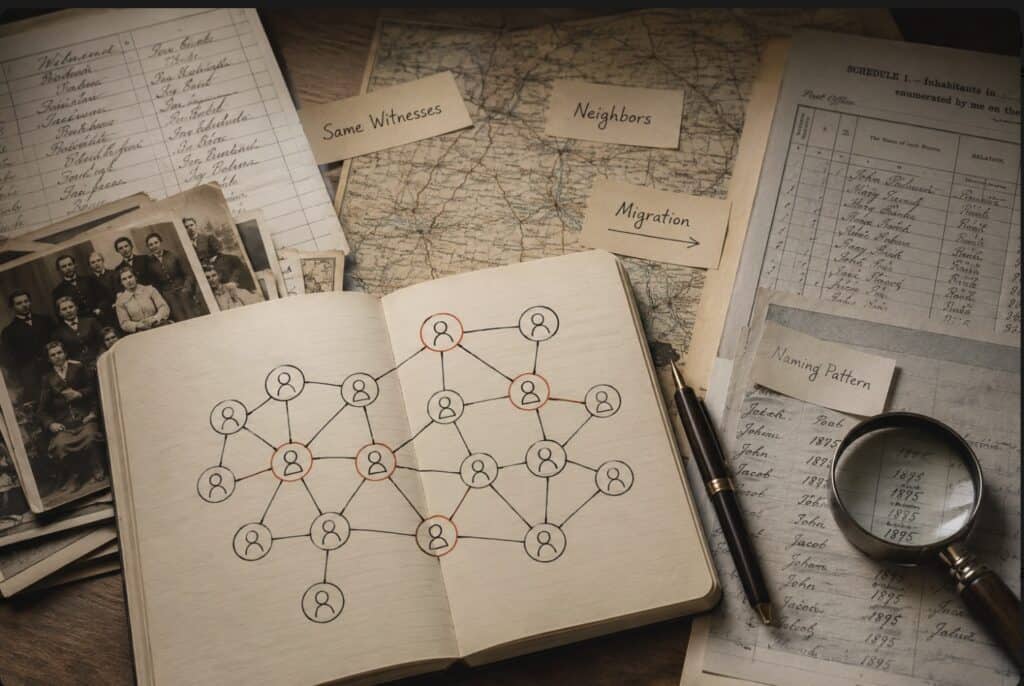
- The same surname appears repeatedly among witnesses
- Several neighboring families migrate together
- A naming pattern repeats across generations
- An occupation remains consistent through multiple records
- DNA matches consistently point toward one branch of the family
- Multiple records place the same families in the same community over decades
None of these observations may seem decisive on its own.
But together they often reveal patterns that individual records cannot.
Patterns Still Need Testing
One important lesson is that patterns suggest.
They do not prove.
Experienced genealogists continue asking questions such as:
- Is this pattern consistent across multiple sources?
- Could another explanation fit the evidence just as well?
- What evidence would contradict this interpretation?
Patterns deserve attention.
They also deserve careful evaluation.
What Genealogy Teaches About Pattern Recognition
One of genealogy’s greatest lessons is that understanding grows through pattern recognition as much as discovery.
Over time, researchers stop asking only:
“What does this record tell me?”
They also begin asking:
“What keeps happening?”
That subtle shift changes the way we investigate.
Individual facts become more meaningful when they are viewed as part of a larger pattern.
Because individual facts provide information.
Patterns reveal understanding.
Key Takeaways
- Genealogy begins with facts, but deeper understanding often comes through pattern recognition
- Repeated surnames, locations, occupations, relationships, and DNA connections can reveal patterns that individual records cannot
- Patterns suggest explanations, but they still need to be tested against the evidence
- Researchers gain insight by asking not only what a record says, but what keeps happening across multiple records
- Pattern recognition helps transform isolated facts into a larger, more coherent understanding of a family
About the Author
Gary Katz is a professional genealogist and DNA detective specializing in Jewish and Eastern European family research, DNA analysis, and lineage reconstruction. He writes about evidence, uncertainty, and decision-making through the lens of genealogy.
To follow Genealogy Gary’s ongoing work: