Every genealogist hopes to find the record that answers everything.
- A birth certificate naming the parents.
- A passenger list identifying the hometown.
- A probate file that neatly explains an entire family.
Sometimes discoveries like these happen.
More often, they don’t.
Instead, genealogy advances through a series of observations that seem almost insignificant when viewed individually.
For example:
- A witness whose surname appears elsewhere in the family
- An occupation repeated across multiple records
- A census household living next door to familiar relatives
- A slight variation of a surname that appears consistently
- A DNA match whose family came from the same village
None of these observations proves a relationship.
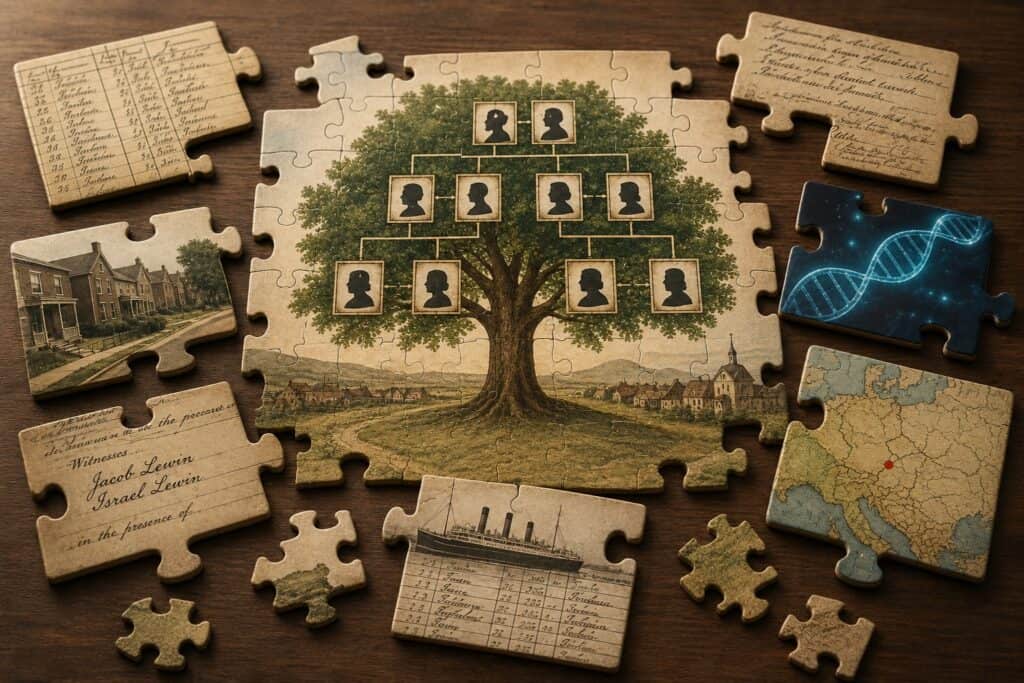
Yet each contributes another piece to the puzzle.
Over time, those small pieces begin reinforcing one another until a conclusion becomes increasingly difficult to ignore.
That is how many of genealogy’s strongest conclusions are built.
Small Clues Rarely Stand Alone
One of the biggest misconceptions about genealogy is that important discoveries arrive all at once.
In reality, most breakthroughs happen gradually.
- A census record provides a location
- A naturalization record confirms an immigration year
- A marriage witness introduces a surname that appears again in other records
- A DNA match connects descendants of the same extended family
Each discovery may seem modest.
But each changes how the others are understood.
Eventually, what once appeared to be unrelated observations begins to form a coherent explanation.
The Power Comes From Correlation
A single clue usually raises a question.
Several independent clues pointing in the same direction begin answering it.
Imagine discovering that an ancestor:
- Lived in the same neighborhood as another family of interest
- Worked in the same occupation over multiple decades
- Appeared repeatedly with the same witnesses
- Belonged to the same religious congregation
- Shared DNA with multiple descendants of that family
None of these facts independently establishes a relationship.
Together, however, they begin supporting one explanation more convincingly than competing alternatives.
The conclusion becomes stronger not because one clue became more important, but because the clues reinforce one another.
When Small Clues Change Everything
I was recently asked to identify the European origins of a client’s grandfather, whose family history had remained unresolved for generations.
No single record provided the answer.
Instead, the breakthrough emerged from a collection of seemingly modest clues.
For example:
- Primary records associated the grandfather with four different given names, one of which ultimately proved to be his father’s name rather than his own
- The family used a much shorter surname in the United States than the multisyllabic surname found in earlier records
- A naturalization record contained a partial reference to a town that initially seemed too vague to be useful
- Other records consistently pointed toward the Minsk Gubernia
- A witness sharing the family’s original surname appeared on primary records, suggesting a close relationship
- DNA matches identified promising sibling and paternal-grandmother cousin candidates
- Online family trees provided hypotheses that required independent verification rather than acceptance at face value
None of these clues solved the mystery independently.
Taken together, however, they began reinforcing one another. Documentary evidence, DNA matches, naming patterns, family associations, and geography all pointed toward the same extended family.
As each hypothesis was independently verified, the family tree expanded outward to include siblings, cousins, and earlier generations. Those newly identified relatives ultimately connected to historical JewishGen records that traced the family to a single shtetl in the former Minsk Gubernia.
What began as a handful of disconnected clues ultimately extended the client’s ancestry by five previously unknown generations.
The breakthrough did not come from discovering one extraordinary record.
It came from recognizing that many ordinary clues, each carefully evaluated and independently verified, were quietly telling the same story.
Context Gives Small Clues Their Meaning
Small clues become valuable because they rarely exist in isolation.
Context often transforms an ordinary observation into meaningful evidence.
For example:
- A witness on a marriage record becomes more significant after appearing as a neighbor in later censuses
- An occupation helps explain why two families lived near one another or migrated together
- A shared DNA match becomes more informative when both families can be placed in the same community at the same time
- A recurring place name begins connecting records created years apart
- A familiar surname appears repeatedly within the same circle of relatives and associates
Experienced genealogists rarely evaluate records one at a time.
They evaluate how records relate to one another.
Confidence Grows Incrementally
Strong genealogical conclusions seldom appear suddenly.
They develop gradually as independent observations continue pointing toward the same explanation.
Each new clue increases confidence because it fits within an already developing pattern.
That pattern may include:
- Consistent locations
- Recurring family associations
- Compatible timelines
- Documentary evidence
- DNA evidence pointing toward the same ancestral line
Occasionally, a new record overturns everything.
More often, it simply becomes one more piece that strengthens an explanation already taking shape.
This gradual accumulation of evidence is one reason experienced genealogists are often comfortable expressing confidence without claiming certainty.
The conclusion rests not on one extraordinary discovery, but on many ordinary observations working together.
What Genealogy Teaches About Discovery
One of genealogy’s most valuable lessons is that breakthroughs are rarely dramatic.
They often begin with details that seem too small to matter:
- A witness
- A neighbor
- An occupation
- A recurring place name
- A modest DNA match
Viewed separately, each offers only a hint.
Viewed together, they can reconstruct families, explain migrations, identify relationships, and solve mysteries that once appeared impossible.
The strongest conclusions in genealogy are rarely built on the biggest discoveries.
They are built on the patient accumulation of many small clues that, together, tell a convincing story.
Because genealogy is not simply about finding remarkable records.
It is about learning when ordinary pieces of evidence have become extraordinary in combination.