Over time, genealogy Evolves From collecting information To learning how To Interpret different kinds of evidence
By Gary Katz
Professional Genealogist & Genetic Genealogy Analyst
Genealogists tend to begin a search with a simple assumption:
More evidence will eventually produce more clarity.
And often, that is true.
- More records may strengthen a timeline.
- More documents may clarify relationships.
- More DNA matches may reinforce a conclusion.
But eventually, many researchers encounter a different problem.
The issue is no longer the absence of evidence.
It is that the available evidence does not all carry the same weight.
That realization changes the nature of genealogy itself.
Because genealogy is not simply the collection of information.
It is the interpretation of evidence.
Why More Evidence Does Not Always Create More Clarity
One of the most surprising things about genealogy is that additional evidence does not always simplify the search.
Sometimes it complicates it.
- Dates conflict.
- Names overlap.
- Ages shift across records.
- Different documents describe the same person differently.
At first, these contradictions can feel frustrating.
But over time, experienced genealogists begin to recognize something important:
Not all evidence should be interpreted equally.
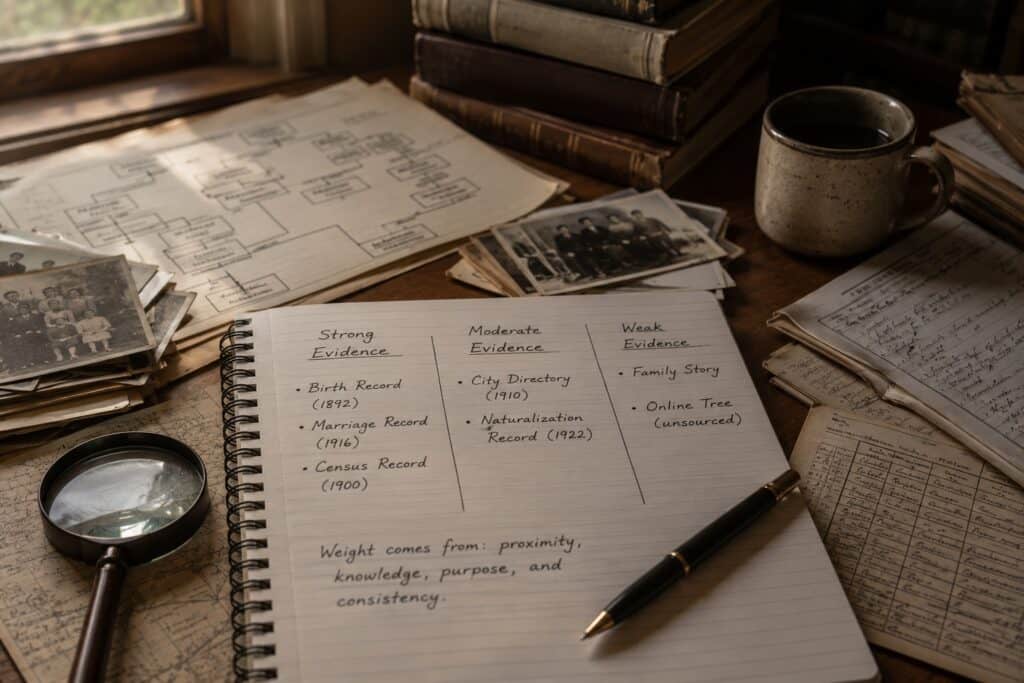
Some records naturally carry more weight than others.
What Changes the Weight of Evidence
Several factors affect how genealogists evaluate evidence.
One is proximity to the event itself.
A record created:
- at the time of birth
- by someone with direct knowledge
- for an official purpose
will often carry more interpretive weight than a record created decades later from memory.
But proximity alone is not enough.
Genealogists also consider:
- who supplied the information
- whether the source had direct knowledge
- how much interpretation the record requires
- whether independent sources support the conclusion
- whether contradictory evidence exists
Over time, researchers learn that evaluating evidence is rarely a binary process.
It is comparative.
Why Conflicting Evidence Is Normal
Many newer researchers assume strong genealogy should eliminate contradiction.
But in practice, contradiction is extremely common.
Especially in:
- immigrant communities
- multilingual populations
- patronymic naming systems
- regions with incomplete documentation
records frequently disagree.
The question is not:
“Why does conflict exist?”
The question becomes:
“What does this conflict mean, and how much weight should each piece of evidence carry?”
That shift is fundamental.
Because strong genealogy is not the absence of contradiction.
It is the responsible interpretation of contradiction.
The Difference Between Loud Evidence and Strong Evidence
Some evidence feels persuasive simply because it is visible, detailed, or emotionally compelling.
But stronger evidence is not always louder evidence.
A dramatic family story may feel convincing.
A detailed online tree may appear authoritative.
A repeated assumption may begin to look established simply because it appears in multiple places.
But genealogy teaches an important lesson:
Repeated information is not automatically independent evidence.
And emotionally satisfying explanations are not automatically stronger explanations.
Sometimes the quieter evidence carries more weight:
- a contemporary document
- a collateral relationship
- a consistent migration pattern
- a cluster of indirect records pointing in the same direction
How Confidence Actually Develops
Many genealogy conclusions are not built from one decisive record.
They emerge gradually.
Confidence increases when:
- independent sources begin aligning
- timelines remain coherent
- contradictions weaken over time
- alternative explanations become less plausible
- multiple forms of evidence support the same interpretation
That process often feels less dramatic than people expect.
But it is how much of genealogy actually works.
Not through certainty appearing suddenly . . .
But through evidence gradually accumulating enough weight to support a reasonable conclusion.
What Genealogy Teaches About Evidence
Over time, genealogy changes how researchers think about evidence itself.
You begin realizing:
- evidence is not equally reliable
- interpretation matters
- confidence is constructed gradually
- stronger evidence is not always more visible evidence
And perhaps most importantly:
You learn that evaluating evidence is not simply about finding information.
It is about learning how to think carefully about the information you find.
About the Author
Gary Katz is a professional genealogist and DNA detective specializing in Jewish and Eastern European family research, DNA analysis, and lineage reconstruction. He writes about evidence, uncertainty, and decision-making through the lens of genealogy.
To follow Genealogy Gary’s ongoing work: