Why Looking Beyond a Single Genealogical Discovery Can Reveal an Entire Network of Family Connections
By Gary Katz
Professional Genealogist & Genetic Genealogy Analyst
As many of us gather with family and friends this Thanksgiving, we’re reminded that our family histories extend far beyond the individuals whose names appear in our family trees.
Our ancestors’ lives were shaped by their relationships with relatives, neighbors, friends, and the communities in which they lived. Those connections are often preserved in historical records — although not necessarily in the individual entries we were searching for.
Consider a familiar experience in genealogical research.
You’ve finally found your ancestor in a historical record.
The name looks right. The age is consistent with what you know. The location makes sense. Perhaps the record even identifies a previously unknown family member.
You save the document, attach it to your family tree, and move on to the next search.
But how much attention did you give to the information surrounding that discovery?
- What was on the preceding page?
- Who appeared immediately below your ancestor?
- What did the column headings actually mean?
- Were there additional entries concerning the same family elsewhere in the volume?
- What determined why your ancestor appeared in that particular collection of records in the first place?
Sometimes the most revealing information isn’t contained within the record we’ve discovered, but in the records surrounding it.
A genealogical document rarely exists in isolation. It belongs to a larger administrative, geographic, historical, or social structure. Understanding that structure can reveal connections that aren’t immediately apparent when we examine an individual record.
A Search Result Is Not the Entire Source
Digital genealogy platforms have transformed our ability to locate historical records. We can search millions of names, filter results by location and date, and find documents that once required considerable archival research.
But the convenience of indexed records can also narrow our perspective.
A typical search result might provide:
- An individual’s name and estimated birth year.
- A location associated with the record.
- The names of immediate family members.
- A transcription of selected information.
- An image of the original document, when available.
These details may be exactly what we were looking for. Yet they represent only a portion of the larger historical source.
The original volume might contain introductory pages, administrative instructions, supplementary entries, corrections, or additional households that never appear prominently in our search results.
An index helps us locate information. It doesn’t necessarily help us understand everything surrounding that information.
Finding an ancestor in a collection and understanding the collection itself are two different accomplishments.
What Can the Adjacent Pages Tell Us?
Historical records were often organized according to principles that made sense to the people who created them. Those principles might not be immediately obvious to a modern genealogist.
Depending on the collection, records could have been organized by:
- Geographic location, neighborhood, or street.
- Household, property, or family registration number.
- Religious affiliation or community membership.
- Occupation, legal status, or taxation category.
- Chronological order of events or registration.
- Administrative jurisdiction.
The organizational structure determines how much significance we should assign to nearby entries.
For example, neighboring households in a census might reveal geographic proximity, while consecutive marriage entries might simply reflect the dates on which couples married.
Two families appearing next to each other in a register aren’t necessarily related. But understanding why they appear together can help us determine whether the proximity deserves further investigation.
The preceding and following pages may also reveal information missing from the page we initially located, including headings, household continuations, annotations, or the beginning of a new administrative section.
Sometimes we need to expand our view simply to understand what we’re looking at.
The Household That Extends Beyond the Page
One of the practical risks of concentrating on a single record image is that the information we’re seeking may extend across multiple pages.
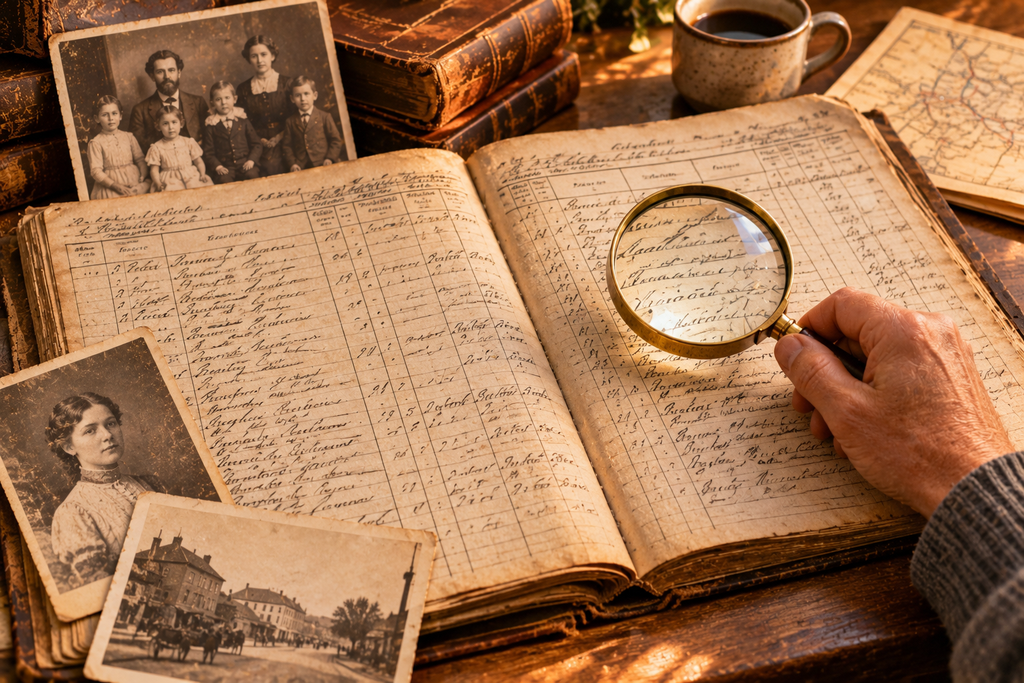
Consider a historical household register that begins with a couple and their children.
The bottom of the page appears to complete the family entry. But the following page might identify additional household members, including:
- Married sons and their families.
- Unmarried daughters or siblings.
- Elderly parents.
- Orphaned relatives.
- Individuals whose relationship to the household requires further investigation.
A supplementary entry elsewhere in the volume might document a birth, death, departure, or transfer that occurred after the original household was recorded.
Without examining those additional pages, we might reconstruct only part of the family.
This is particularly important when working with handwritten registers whose structure isn’t fully represented in modern indexes.
What appears to be a complete family entry may actually be one portion of a much larger household.
When the Collection’s Title Matters
Sometimes the most important information about a record isn’t written alongside our ancestor’s name. It’s contained in the title or administrative description of the collection itself.
This can be especially significant in Eastern European genealogical research.
Historical revision lists in the Russian Empire, for example, were created for administrative and taxation purposes rather than to provide future generations with family histories.
Different lists could document populations according to their registered social or legal status. A collection might cover:
- Registered townspeople.
- Merchants.
- Peasants associated with particular estates or communities.
- Members of agricultural settlements.
- Other designated administrative or population categories.
The precise categories and their application varied by locality and historical period.
An ancestor associated with a particular town might therefore be absent from one collection but recorded in another covering the same general area.
The problem may not be that the ancestor was missing from the historical records. We may simply have been searching the wrong category of records.
Before drawing conclusions from an unsuccessful search, it’s worth asking whether the collection actually included the population to which our ancestors belonged.
Understanding who was supposed to appear in a record can be just as important as understanding who actually appears.
Family Numbers, Household Numbers, and Other Identifiers
Historical registers often contain numerical identifiers whose significance isn’t immediately apparent.
A number recorded beside an ancestor might represent a household, property, family registration, taxation unit, or sequential entry. These identifiers can become valuable genealogical clues when their meaning is understood.
A later revision list, for example, might reference a family’s registration in an earlier revision. That reference could help locate an earlier generation or distinguish between households with similar names.
But a number shouldn’t automatically be treated as a permanent identifier.
Administrative systems changed. Households divided. Families transferred between jurisdictions or registration categories. Records could be reorganized or renumbered.
Two households with the same number in different collections may have no connection, while the same family may appear under different numbers over time.
The surrounding records can help establish whether a numbering system follows a recognizable pattern.
We may discover that numbers refer to earlier registrations, that they restart within each community, or that multiple related households appear under a common administrative entry.
The number itself is a clue. The larger source helps us interpret it.
The People Who Appeared With Our Ancestors
Genealogical records frequently identify people who aren’t members of the immediate family being documented.
These individuals may receive relatively little attention when our search is focused on a particular ancestor. Yet their appearances can reveal important social and family connections.
Different records provide different opportunities to identify these associated individuals:
- Marriage records may identify witnesses whose relationship to the couple becomes meaningful through additional research.
- Birth and baptismal records may identify godparents, sponsors, or other participants.
- Passenger manifests may identify traveling companions, relatives in the country of origin, or contacts at the destination.
- Naturalization records may identify witnesses who knew an immigrant personally.
- Census records may reveal relatives, neighbors, boarders, or extended family members living nearby.
- Probate records may identify beneficiaries, guardians, creditors, and individuals entrusted with family responsibilities.
Not every associated individual was a relative. Some were neighbors, friends, business associates, officials, or professional witnesses.
The value often emerges when the same person or family appears repeatedly across different records.
A marriage witness might later appear as a neighbor in a census. A passenger listed near an ancestor might share a destination address. An unfamiliar surname might eventually appear in a DNA match’s family tree.
Those repeated connections can provide a foundation for investigating relationships that weren’t explicitly documented.
When Nearby Families Become Relevant
Imagine searching an Eastern European household register and discovering a family with the surname you’ve been investigating.
Several pages away, another household carries a surname that you recognize from a different branch of your family tree.
At first, the two discoveries may seem unrelated.
But further examination reveals that the families lived in the same community during the same period. A later marriage record connects their descendants, or additional records identify relationships between their households.
What began as a search for one ancestor has now created a possible connection between two family lines.
This illustrates an important characteristic of genealogical research: a discovery can be relevant to more than the question that originally prompted the search.
A record encountered while investigating one family may contain information that becomes valuable months or even years later, when we’re investigating another.
We don’t need to reconstruct every household in a historical register. But recognizing familiar surnames, recurring individuals, and potentially meaningful associations can help us preserve clues whose significance isn’t immediately apparent.
The Same Principle Applies to DNA Matches
Genetic genealogy provides another opportunity to examine the information surrounding an individual discovery.
When we identify a promising DNA match, our attention naturally focuses on the possible relationship between that person and ourselves.
We examine the amount of shared DNA, the estimated relationship, and the match’s family tree. But the broader network may offer additional clues.
Depending on the testing platform and the information available, we might also examine:
- Shared DNA matches and their documented family relationships.
- Recurring ancestral surnames across several match trees.
- Ancestral communities represented among those matches.
- Shared chromosome segments and potential triangulation.
- Descendants of different children of a proposed ancestral couple.
Each of these perspectives can help develop or test a possible explanation for the connection.
However, shared matches don’t automatically establish a common ancestor, and even a triangulated segment doesn’t necessarily identify the specific ancestor from whom it was inherited.
This distinction is especially important in endogamous populations, where individuals may share DNA through multiple ancestral lines.
The surrounding network is valuable because it provides additional evidence and alternative possibilities — not because every connection must lead to the same conclusion.
A DNA match that initially seems relevant to one branch may ultimately prove more informative about another.
Preserve More Than the Discovery
The information we retain during a search can influence our ability to interpret a discovery later.
Saving an individual record image is certainly useful. But depending on the source, it may also be worth preserving additional information:
- The complete archival reference or collection citation.
- The original volume title and administrative description.
- Relevant headings and explanatory pages.
- Adjacent images containing related entries or household continuations.
- Notes about recurring surnames, individuals, and communities.
- Observations about how the records appear to be organized.
This doesn’t mean downloading every page of every collection we encounter.
The objective is to preserve enough context to understand the discovery and revisit potentially important connections without having to reconstruct the entire search.
A familiar surname that seems incidental today may become recognizable after a new DNA discovery tomorrow.
A household number that initially appears meaningless may help connect two generations after an earlier revision list becomes available.
Context often becomes more valuable as our understanding of the family develops.
How Far Beyond the Record Should We Look?
There isn’t a universal answer.
Some discoveries can be understood adequately within a single document. Others open research opportunities that extend across pages, volumes, communities, and generations.
My own approach is exploratory. A new discovery may suggest several directions, and its relevance isn’t always limited to the family I was originally investigating.
What matters is recognizing when the surrounding information offers something worth pursuing.
A recurring surname, an unexplained annotation, an unfamiliar administrative category, or an unexpected DNA connection may justify expanding the search.
Other surrounding information may have little bearing on anything we’re investigating.
The goal isn’t to examine everything indiscriminately. It’s to remain receptive to clues that a narrowly focused search might otherwise overlook.
We can search with a particular question in mind without limiting ourselves to the information we expected to find.
From Individual Records to Family History
Historical documents were created within systems that connected people to households, communities, governments, religious institutions, and one another.
When we isolate an individual entry, we may lose sight of those connections.
The surrounding records can help us understand not only who our ancestors were, but also:
- How their households were structured.
- Which families lived or traveled alongside them.
- How they were classified within historical administrative systems.
- What relationships extended beyond their immediate households.
- Which other records might document their lives.
These discoveries can transform an isolated name into a more meaningful understanding of a family and its circumstances.
Sometimes we find the answer in the record we were searching for. Sometimes we find it on the preceding page, in a neighboring household, or in an entirely different section of the same collection.
And sometimes the information we discover becomes valuable to a family line we weren’t even investigating.
The next time you find your ancestor in a historical record, take a moment to consider what surrounds that discovery. The record you found may be only the beginning of what the source has to tell you.
Key Takeaways
- Indexed search results provide access to historical information but may omit important context from the original collection.
- Adjacent pages can reveal household continuations, annotations, additional relatives, and administrative details.
- Understanding the population covered by a historical collection can help explain why an ancestor appears in one source but not another.
- Household and family registration numbers require interpretation within their original administrative systems.
- Witnesses, neighbors, traveling companions, and other associated individuals may provide clues to previously unidentified relationships.
- DNA match networks can reveal additional ancestral connections while also introducing competing explanations.
- Preserving contextual information can make discoveries more useful as research into several family lines develops.
- A focused search can remain exploratory without requiring an exhaustive investigation of every surrounding record.
About the Author
Gary Katz is a professional genealogist and DNA detective specializing in Jewish and Eastern European family research, DNA analysis, and lineage reconstruction. He writes about evidence, uncertainty, and decision-making through the lens of genealogy.
Have a Family History Mystery You’d Like to Solve?
Have a family-history question you haven’t been able to answer — or DNA matches you’re unsure how to interpret?
I offer focused genealogical assessments to help clarify what your evidence supports, identify promising research directions, and determine where additional investigation may be worthwhile.
Request an Introductory Conversation
Introductory conversations are available by arrangement.
Continue Your Family History Research
Prefer to work through your family-history questions yourself? I’ve developed resources to help you approach common research challenges with greater clarity and confidence.
Explore these resources:
- When Your Family History Doesn’t Add Up — For researchers facing conflicting evidence, unanswered questions, or family stories that don’t quite fit together.
- The Cousin Connection Kit — For exploring family connections and making better use of information shared by relatives.
- The Family History Workbook — For organizing your discoveries and developing a clearer picture of your family’s history.
Explore Genealogy Gary’s Family History Research Resources
For ongoing genealogy insights and research guidance, subscribe to Genealogy Gary’s Roots Roundup.