Records Rarely Speak for Themselves . . . Understanding Comes From Seeing Them Within the Larger Story
By Gary Katz
Professional Genealogist & Genetic Genealogy Analyst
One historical record can answer an important question . . .
But it rarely tells the whole story.
- A birth record identifies parents
- A census places a family in a particular location
- A probate file reveals relationships
Each provides valuable information.
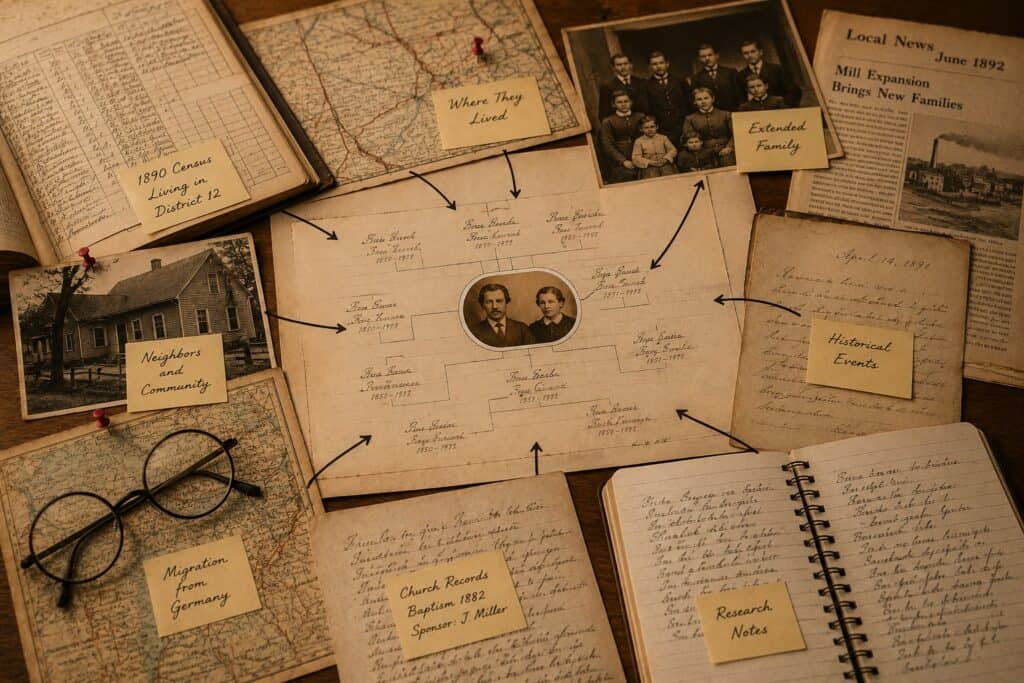
Yet every record also exists within a larger historical, social, and family context.
Understanding that context is often what transforms information into insight.
Every Record Has a Story Around It
Researchers sometimes focus so intently on the information contained within a record that they overlook the circumstances surrounding it.
Questions such as these often reveal as much as the record itself:
- Who were the neighbors?
- What was happening in the community?
- Why did the family move?
- Which relatives lived nearby?
- What historical events may have influenced their decisions?
Those surrounding details often explain why a record looks the way it does.
Context Changes Interpretation
The meaning of a record is not fixed.
It depends on what researchers know about the people and circumstances connected to it.
For example:
- A surname may appear to change because of immigration.
- An age may vary because birthdays were estimated.
- A family may disappear from one census because county boundaries changed.
- A missing record may reflect historical events rather than poor research.
Without context, these details can appear contradictory.
With context, they often become understandable.
Families Rarely Lived in Isolation
Genealogy is not simply the study of individuals.
It is the study of people within families, communities, and historical events.
Researchers often gain valuable insight by examining:
- Extended family members.
- Neighbors.
- Witnesses.
- Sponsors.
- Traveling companions.
- Business associates.
Sometimes the people surrounding an ancestor reveal more than the ancestor’s own records.
Context Strengthens Conclusions
Context does not replace evidence.
It strengthens its interpretation.
As researchers better understand the world their ancestors lived in, they become better equipped to:
- Evaluate competing explanations.
- Recognize reasonable assumptions.
- Interpret conflicting records.
- Build more convincing conclusions.
The evidence has not changed.
The understanding has.
What Genealogy Teaches About Understanding
One of the greatest lessons genealogy teaches is that records rarely exist in isolation.
Neither do people.
Every ancestor lived within a network of family, neighbors, communities, and historical events.
The more completely researchers understand that larger picture, the more clearly individual records begin to make sense.
Because genealogy is not simply about discovering individual facts . . .
It is about understanding the lives those facts represent.
About the Author
Gary Katz is a professional genealogist and DNA detective specializing in Jewish and Eastern European family research, DNA analysis, and lineage reconstruction. He writes about evidence, uncertainty, and decision-making through the lens of genealogy.
To follow Genealogy Gary’s ongoing work: