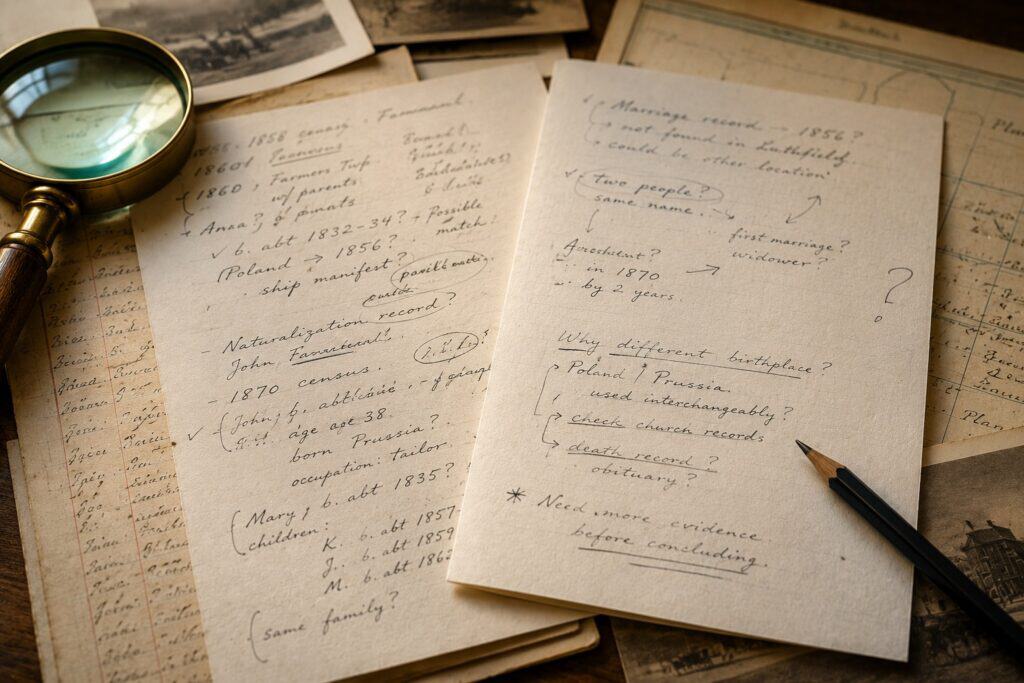
Many genealogy mistakes begin when an assumption quietly starts feeling like a fact.
By Gary Katz
Professional Genealogist & Genetic Genealogy Analyst
One of the most important lessons genealogy teaches is that evidence and assumptions are not the same thing.
That sounds obvious.
But in practice, the distinction is not always easy to maintain.
Over time, assumptions can become familiar.
And familiar ideas often begin feeling true.
That is where problems start.
Because genealogy is not just about finding information.
It is about understanding the difference between:
- what the evidence actually says
- what the evidence suggests
- what the researcher assumes
Those are not the same thing.
Yet they often become blended together.
Why Assumptions Are Necessary
Assumptions are not inherently bad.
In fact, they are often necessary.
Every genealogy search begins with working ideas about:
- identities
- relationships
- migration patterns
- family structures
Those ideas help guide the search.
Without them, it would be difficult to decide:
- which records to pursue
- which archives to search
- which explanations deserve further investigation
Assumptions help create direction.
The problem is not having assumptions.
The problem is forgetting that they are assumptions.
When Assumptions Become Invisible
Most assumptions do not become problematic immediately.
They become problematic when they stop feeling provisional.
A researcher may begin with a hypothesis.
Over time:
- the hypothesis is repeated
- additional information appears consistent with it
- alternative explanations receive less attention
Eventually, the original assumption can start feeling established.
Not because it has been proven.
But because it has become familiar.
That transition is often subtle.
And it can happen without anyone noticing.
Why This Happens So Easily
Genealogy requires spending long periods of time inside the same family structures.
Researchers become familiar with:
- names
- timelines
- relationships
- family stories
The more familiar a structure becomes, the easier it is to stop questioning it.
Confidence gradually increases.
And sometimes confidence begins growing faster than the evidence itself.
That does not mean the conclusion is wrong.
But it does mean the conclusion deserves occasional reexamination.
Because familiarity can create the illusion of certainty.
Family Stories and Documented Facts
Family stories provide a useful example.
Many family stories contain valuable information.
Some turn out to be remarkably accurate.
Others contain:
- distortions
- omissions
- misunderstandings
- details that changed over time
The problem is not the existence of the story.
The problem occurs when the story is treated as evidence rather than something that requires evaluation.
A family story may suggest a direction.
But it is not automatically a documented fact.
That distinction matters.
How Genealogists Separate Evidence From Interpretation
Experienced genealogists often develop habits that help keep assumptions visible.
They ask questions such as:
- What does this record directly state?
- What am I inferring from this information?
- Which parts of this conclusion are documented?
- Which parts remain interpretive?
- What alternative explanations still fit the evidence?
Those questions help separate:
- evidence
- interpretation
- assumption
The goal is not to eliminate interpretation.
Interpretation is an essential part of genealogy.
The goal is to understand where interpretation begins.
Why Visible Assumptions Are Valuable
Assumptions are easiest to evaluate when they remain visible.
A visible assumption can be:
- tested
- challenged
- refined
- discarded if necessary
An invisible assumption cannot.
That is why strong genealogy often involves making assumptions explicit.
Not because they are weaknesses.
But because they are part of the reasoning process.
Once they become visible, they can be evaluated alongside the evidence itself.
What Good Genealogy Actually Requires
Many people think genealogy is primarily about collecting facts.
But the longer you work in genealogy, the more you realize that reasoning matters just as much as discovery.
Records matter.
Evidence matters.
But understanding the difference between evidence and assumption matters too.
Because some of the most significant genealogy mistakes do not occur when evidence is missing.
They occur when assumptions quietly become accepted as facts.
And one of the most valuable skills a genealogist can develop is learning to recognize the difference.
About the Author
Gary Katz is a professional genealogist and DNA detective specializing in Jewish and Eastern European family research, DNA analysis, and lineage reconstruction. He writes about evidence, uncertainty, and decision-making through the lens of genealogy.
To follow Genealogy Gary’s ongoing work: