Not all genealogy conclusions carry the same weight; Confidence Must be Earned Over Time
By Gary Katz
Professional Genealogist & Genetic Genealogy Analyst
Not all genealogy conclusions carry the same degree of confidence.
- Some conclusions feel tentative.
- Some feel likely.
- Some feel highly reliable.
And often, that difference exists even when all of the conclusions are based on real evidence.
That raises an important question:
- Why do genealogists trust some conclusions more than others?
The answer reveals something important about how genealogy actually works.
Confidence Is Not Binary
Many people approach genealogy as if conclusions fall into only two categories:
- Proven.
- Unproven.
In practice, things are rarely that simple.
Most genealogy conclusions exist somewhere between those two extremes.
Researchers often find themselves working with conclusions that are:
- Possible.
- Plausible.
- Probable.
- Highly supported.
The goal is not to achieve certainty in every situation.
The goal is to understand how much confidence a conclusion deserves.
What Builds Confidence
Confidence tends to increase when multiple forms of evidence begin pointing toward the same conclusion.
Researchers gradually become more comfortable with a conclusion when:
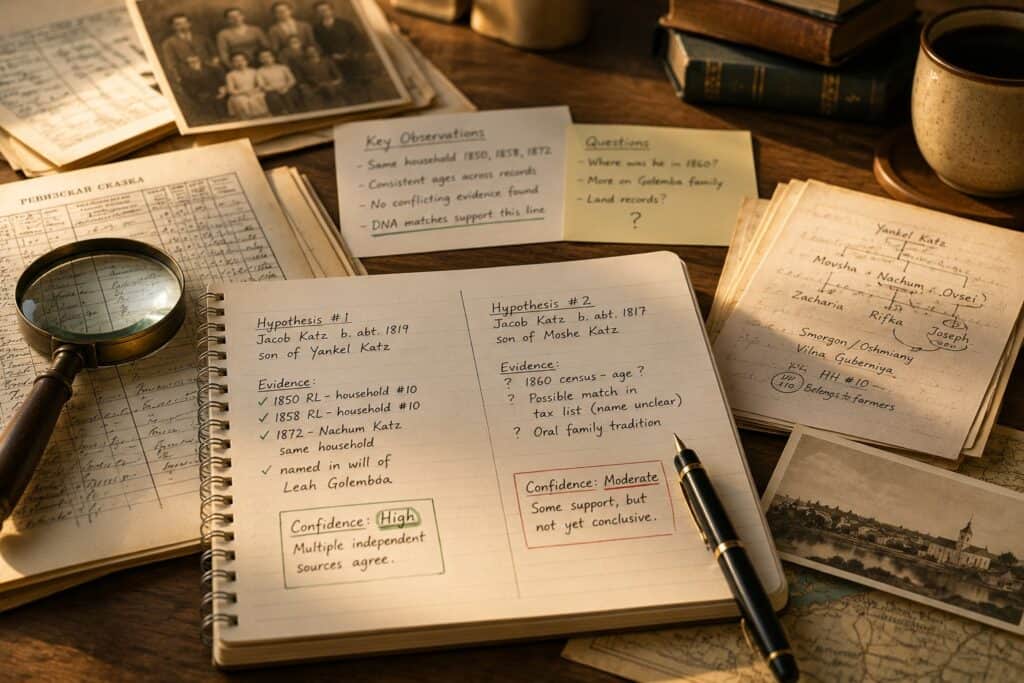
- Multiple independent sources agree.
- The timeline remains consistent.
- Contradictory evidence is limited.
- Alternative explanations become less plausible.
- New evidence continues supporting the same interpretation.
Notice that none of these factors guarantee a conclusion is correct.
Instead, they increase confidence that the conclusion accurately reflects the available evidence.
Confidence grows gradually.
It is rarely created by a single record.
Why Independent Evidence Matters
One reason genealogists place so much value on independent evidence is that it reduces the chance that a conclusion depends on a single mistake.
For example:
- A census record may suggest a relationship.
- A probate record may support the same relationship.
- DNA evidence may point in the same direction.
Each source has limitations.
But when multiple independent sources support the same conclusion, confidence naturally increases.
Researchers are no longer relying on a single piece of evidence.
They are evaluating a larger body of information.
What Reduces Confidence
Confidence can also decrease.
Sometimes evidence exists, but important questions remain unresolved.
Researchers often become more cautious when:
- Key assumptions remain untested.
- Evidence depends heavily on a single source.
- Contradictory records remain unexplained.
- Multiple explanations still fit the facts.
- Significant gaps remain in the research.
A conclusion may still be reasonable.
But reasonable does not always mean highly reliable.
Recognizing that distinction is an important skill.
Why Familiarity Can Be Misleading
One of the reasons genealogists sometimes overestimate confidence is that familiarity feels persuasive.
The longer a conclusion remains in a family tree, the more established it can seem.
Over time:
- The conclusion is repeated.
- The story becomes familiar.
- Researchers stop questioning it.
Eventually, confidence may come from familiarity rather than evidence.
That creates risk.
Because familiarity is not proof.
And repetition does not automatically strengthen a conclusion.
Why Confidence Changes Over Time
Many people assume confidence should remain stable once a conclusion has been reached.
But genealogy rarely works that way.
New information continues to appear:
- New records are discovered.
- New DNA matches emerge.
- New interpretations become possible.
- Previous assumptions are reconsidered.
As a result, confidence can increase . . . or decrease.
Neither outcome necessarily means the earlier work was poor.
It simply reflects the reality that genealogy is an ongoing process of evaluation.
The Difference Between Confidence and Certainty
One of the most valuable lessons genealogy teaches is that confidence and certainty are not the same thing.
Certainty implies no meaningful doubt remains.
Confidence recognizes that some uncertainty may still exist.
Strong genealogists learn to become comfortable with that distinction.
They do not pretend uncertainty has disappeared.
Instead, they learn to calibrate their confidence to the strength of the evidence.
That approach produces stronger conclusions and more reliable research.
What Genealogy Teaches About Trust
Over time, genealogy changes how researchers think about trust itself.
The strongest genealogists do not simply trust conclusions.
They learn why they trust them.
They understand:
- Which evidence supports the conclusion.
- Which assumptions remain involved.
- Which alternative explanations have been tested.
- Which uncertainties still exist.
That understanding creates a different kind of confidence.
- Not certainty.
- Not blind belief.
But confidence that has been earned through careful evaluation of the evidence.
And in genealogy, that may be the most trustworthy kind of confidence there is.
About the Author
Gary Katz is a professional genealogist and DNA detective specializing in Jewish and Eastern European family research, DNA analysis, and lineage reconstruction. He writes about evidence, uncertainty, and decision-making through the lens of genealogy.
To follow Genealogy Gary’s ongoing work: