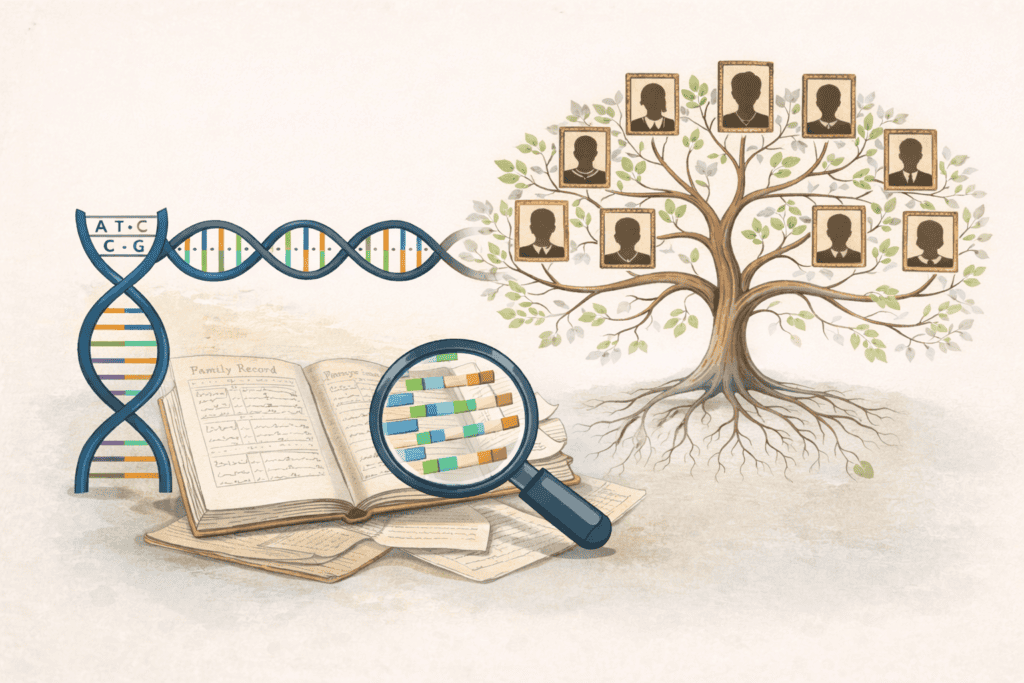
DNA evidence integrated with documentary research to reconstruct ancestral relationships.
By Gary Katz
Professional Genealogist & Genetic Genealogy Researcher
Over the past several articles in this series, I’ve laid out the core stages of my professional genealogy workflow.
If you’re joining the series here, the earlier stages are covered in the following articles:
- How I Turn Family Mysteries Into Ancestral Discoveries
- Building the Tree Foundation
- Verifying the Family Chronicle
- Surfacing Living Cousins
- Experimenting with Big Puzzles
We began by reframing family mysteries as solvable research problems — not dead ends. We built a solid documentary foundation by separating family stories from evidence, verifying oral history against records, and reconstructing trees carefully enough to support real analysis. We then turned outward, identifying and engaging living cousins whose knowledge and records often hold the missing pieces that no archive can provide. Finally, we explored how hypothetical trees — used cautiously and transparently — allow us to test ideas, surface patterns, and push past stubborn brick walls without polluting the factual record.
All of that work leads to a natural next step.
At a certain point, documents thin out. Memories fade. Records disappear, were never created, or were destroyed by war, migration, or bureaucracy. When that happens, traditional genealogy alone can only take you so far.
This is where DNA becomes indispensable.
Not as a novelty . . .Not as a shortcut. . . . And certainly not as a list of ethnicity percentages.
In the fifth stage of my genealogy workflow — Deep Diving into DNA — genetic evidence is used the same way all good evidence should be used: cautiously, methodically, and in direct conversation with the paper trail. DNA does not replace documents. It strengthens them, challenges them, and in many cases extends them into places the records can no longer reach.
From Spit to Story: What DNA Can Really Tell You
It’s easy to think of DNA testing as entertainment — the quick way to learn you’re “32% Baltic” or “12% Scandinavian.”
Those estimates can be interesting, but they are not genealogy.
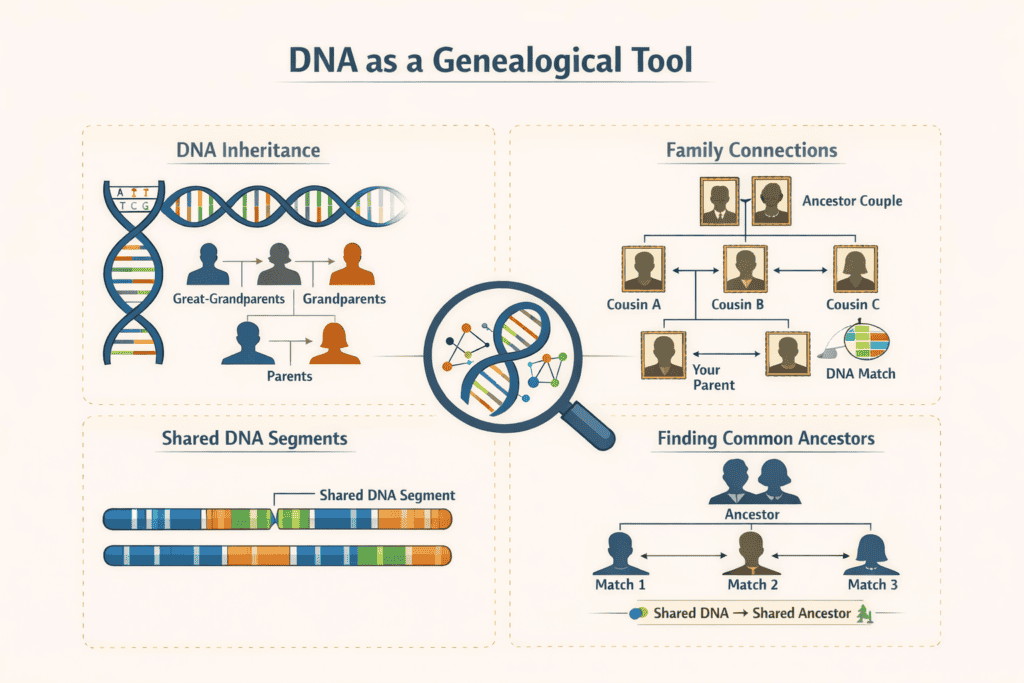
For genealogists, DNA is a relational record. It documents how living people are biologically connected through shared ancestors, even when names, places, and paperwork have been lost. Its real power emerges only when you move past ethnicity and begin analyzing shared DNA segments, match networks, and triangulated relationships.
Used correctly, DNA can:
- Confirm or refute documentary conclusions
- Identify previously unknown family branches
- Reconstruct ancestral lines erased from the written record
- Reveal which hypotheses are plausible — and which are not
DNA is genealogy’s most personal record — written in every one of us — but like any record, it only speaks clearly when interpreted in context.
Step 1: Choose the Right DNA Platforms
Each DNA testing service has unique strengths. Professional genealogists often test or upload results across several platforms to maximize matches.
- AncestryDNA — Largest database and strong tree integration
- MyHeritage DNA — Strong European coverage and chromosome tools
- FamilyTreeDNA — Y-DNA and mtDNA testing with advanced analysis
- 23andMe — Detailed segment data and haplogroups
- GEDmatch — Cross-platform comparison and analysis
- LivingDNA — British Isles specialization
For serious research, begin with AncestryDNA, then transfer your raw DNA file to additional platforms to broaden your match pool.
Step 2: Start with Shared Matches, Not Ethnicity
Ethnicity percentages are conversation starters, not genealogical evidence.
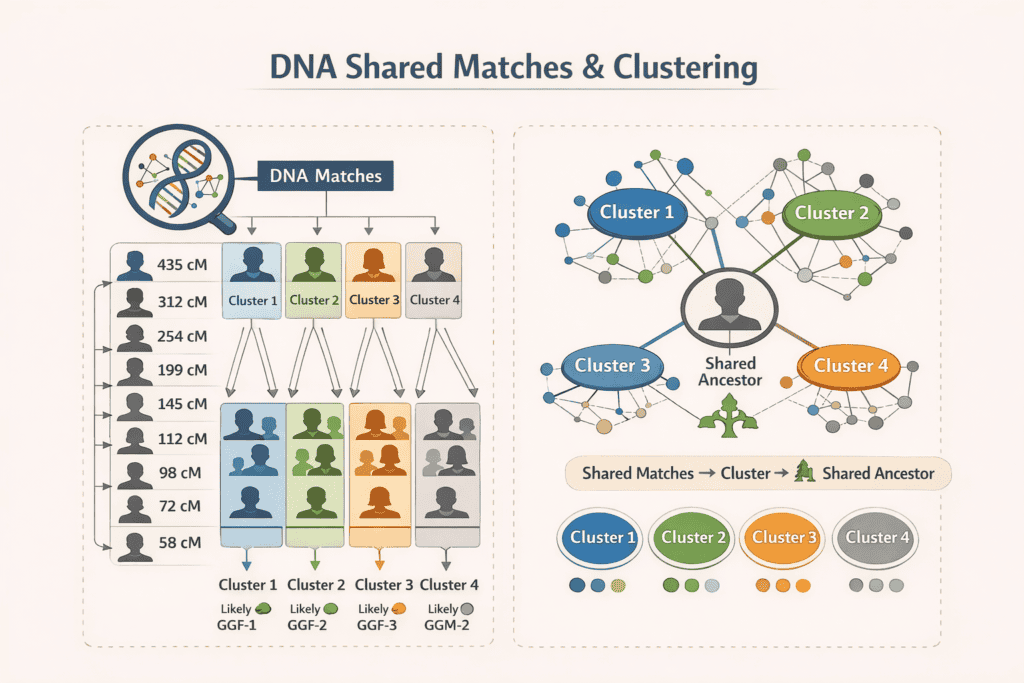
To turn DNA into discovery, focus on shared matches — the people who share overlapping DNA segments with you.
Action Plan
- Sort matches by total shared centimorgans (cM)
- Group matches by likely relationship range
- Look for repeating surnames or locations
- Use shared-match tools to reveal relationship networks
Shared matches point to shared ancestors — your task is to determine who they are.
Step 3: Use DNA “Super Tools” to Analyze and Visualize
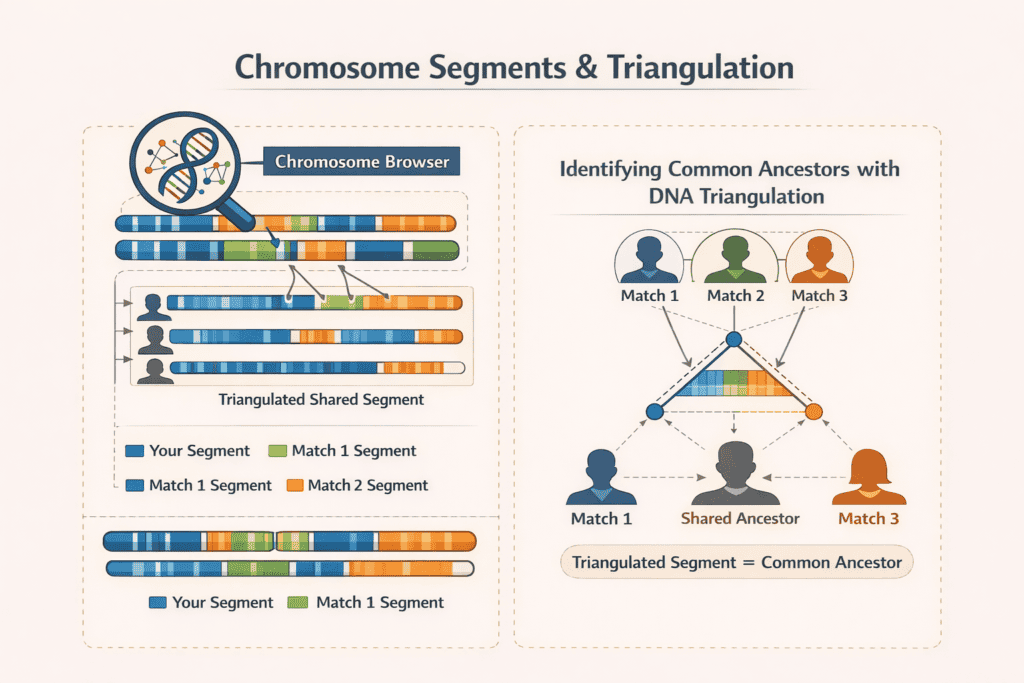
Once matches are grouped, analytical tools allow you to test inheritance and visualize how DNA segments are shared.
Pro Tip: Focus on triangulated segments — DNA segments shared by multiple people who also match one another. These segments can be attributed to a specific common ancestor rather than chance overlap.
Step 4: Organize Matches by Likely Ancestor (The Leeds Method)
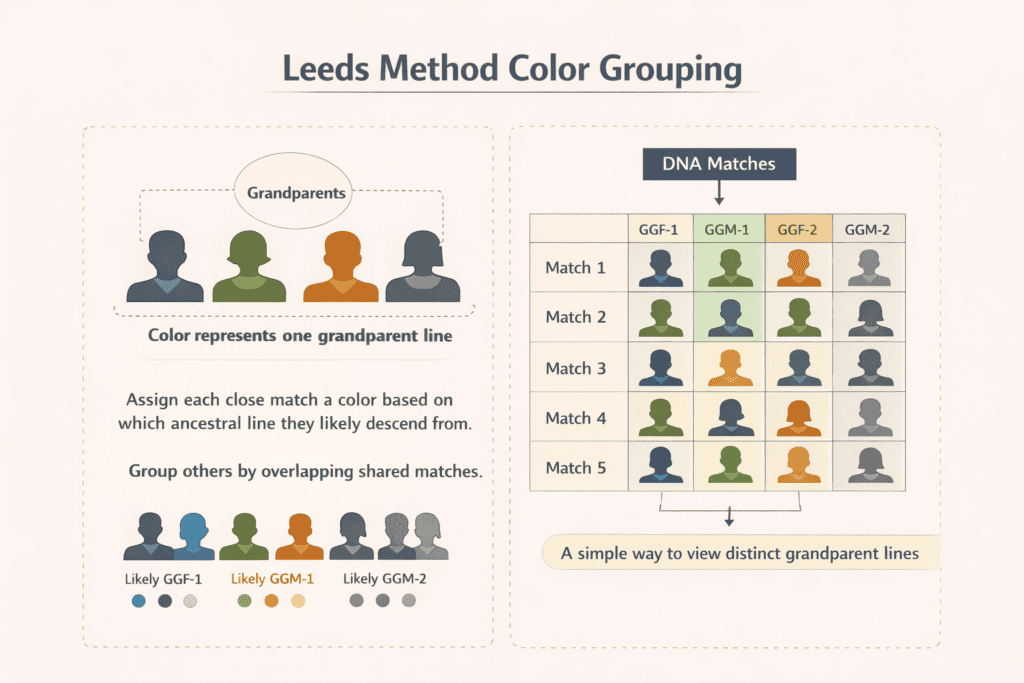
The Leeds Method assigns colors to DNA matches based on which ancestral line they likely descend from, typically corresponding to the four grandparent branches.
Step 4: Organize Matches by Likely Ancestor (The Leeds Method)
As your match list grows, organization becomes essential. One of the simplest and most powerful frameworks is the Leeds Method, which assigns colors to DNA matches based on which ancestral line they likely descend from — typically corresponding to the four grandparent branches.
Other systems, such as SMARTTA (Sorting, Mapping, Analyzing, Researching Through Triangulated Analysis), build on this idea by adding additional layers of rigor. SMARTTA is especially valuable in endogamous populations — including Ashkenazi Jewish ancestry — where DNA matches often share multiple ancestral paths.
By emphasizing triangulated DNA segments, contextual analysis, and close integration with documentary research, SMARTTA helps distinguish true shared ancestry from background relatedness, reducing false assumptions in complex genetic networks.
By categorizing and evaluating matches within these frameworks, you can visualize which family branches are well represented — and which remain genetic blind spots.
DNA without organization is data; DNA with structure becomes genealogy.
By organizing matches visually, you can quickly identify which family lines are genetically well represented — and which remain blind spots.
DNA without organization is data; DNA with structure becomes genealogy.
Step 5: Connect DNA to the Paper Trail
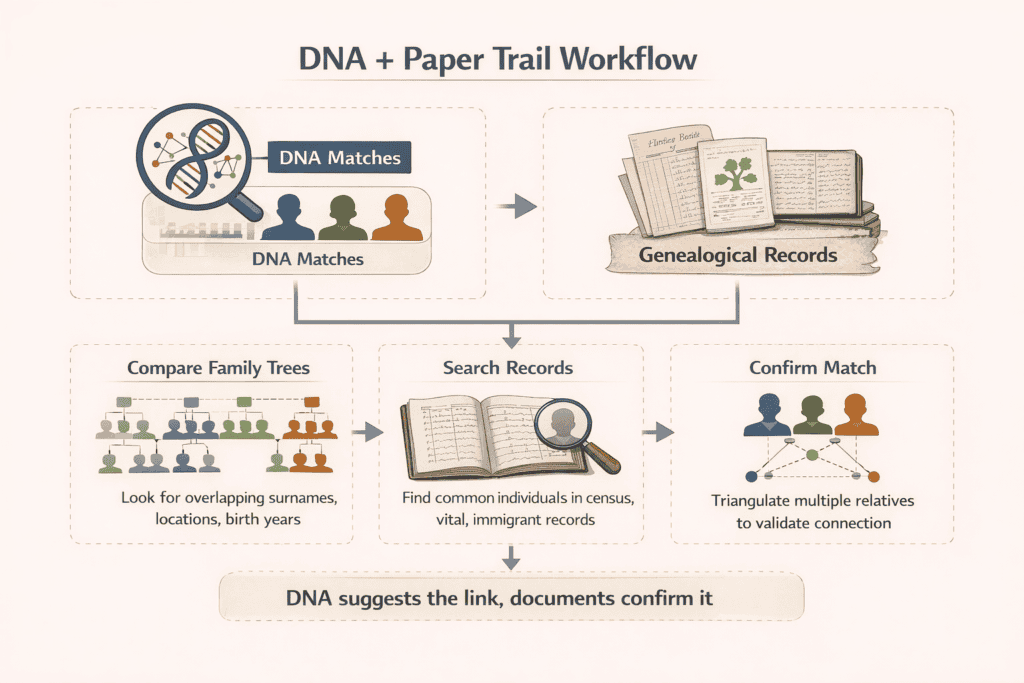
DNA can suggest relationships, but documentary evidence provides confirmation.
When a DNA match indicates a possible connection:
- Compare family trees for overlapping names, places, and dates
- Search census, vital, immigration, and other records
- Confirm the relationship through triangulation and multiple matches
DNA gives hints. Records give proof.
Step 6: Go Beyond Autosomal — Y-DNA and mtDNA
Autosomal DNA answers many questions, but Y-DNA and mtDNA allow you to trace direct paternal and maternal lines with greater precision.
These tests are especially valuable for surname studies, deep lineage reconstruction, and distinguishing unrelated families with similar names.
Step 7: Interpret Results in Context
DNA results do not exist in a vacuum. Numbers alone do not tell stories — context gives them meaning.
Interpret genetic evidence through geographic patterns, historical events, migration routes, and cultural naming traditions. Understanding where and how families lived is often as important as the amount of DNA they share.
In populations with significant historical endogamy — including Ashkenazi Jewish ancestry — apparent closeness between DNA matches may reflect multiple shared ancestral paths rather than a single recent relationship. In these cases, interpretation requires particular care.
Prioritize triangulated DNA segments, consistency across multiple matches, and integration with documentary research over raw centimorgan totals or automated relationship estimates. These safeguards help distinguish meaningful shared ancestry from background relatedness.
Step 8: Respect Privacy and Ethical Boundaries
Genetic genealogy involves living people and sensitive information.
- Obtain consent before sharing DNA results
- Avoid publishing identifiable match data without permission
- Handle unexpected discoveries with care and professionalism
The Genome as a Genealogy Journal
Every person carries a genetic journal written across generations.
By reading that journal carefully — and integrating genetic evidence with historical records — we can recover stories once thought lost.
DNA deep dives do not replace traditional genealogy. They refine it.
The deeper you go, the clearer your ancestral picture becomes.
Next in the Genealogy Workflow
Article 7: Publishing for Posterity — How to Share and Preserve Your Family Research
About the Author
Gary Katz is a professional genealogist and DNA detective specializing in Jewish and Eastern European family research, DNA analysis, and lineage reconstruction. He helps clients make sense of their ancestry and document their heritage.
If you’d like to follow along as I continue this work, I occasionally share notes and reflections in my
Genealogy Gary Roots Roundup
.
If you’re facing a complex research question and want help clarifying what the evidence actually supports, the best place to begin is with a focused assessment.
3 Comments