
People Rarely Moved Alone . . . Understanding Who Moved Together Often Explains Why They Moved
By Gary Katz
Professional Genealogist & Genetic Genealogy Analyst
When we find an ancestor in a new place, it’s tempting to focus on one question.
When did they move?
Experienced genealogists eventually begin asking a different question.
Who moved with them?
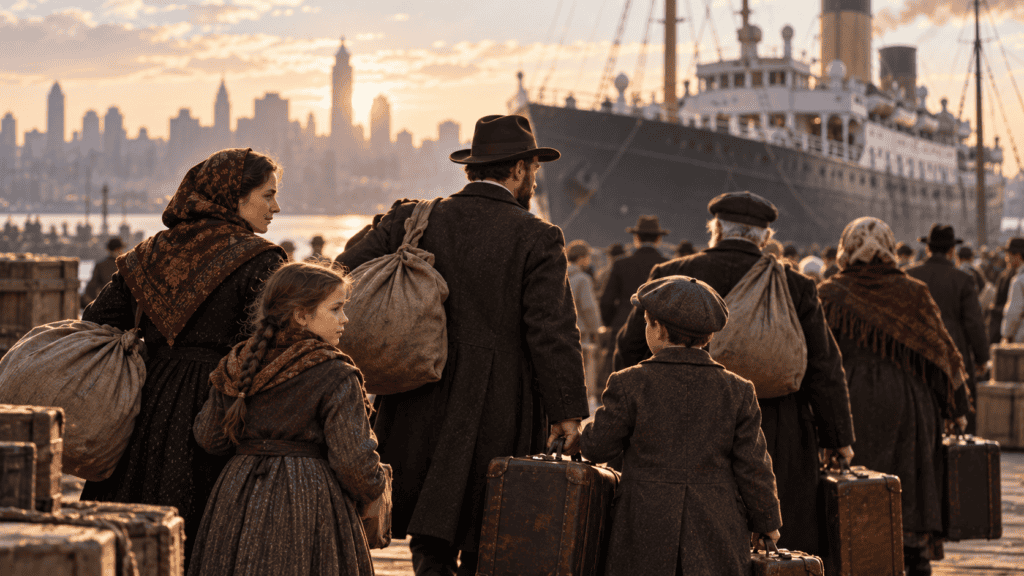
People rarely migrated in isolation.
- Families
- Friends
- Neighbors
- Entire communities
Understanding those connections frequently explains why people moved — and where they went next.
Migration Is Usually a Shared Story
Moving has never been easy.
It has always involved uncertainty.
People often relied on those they already knew.
Researchers frequently discover that migrations included:
- Brothers and sisters
- Parents and adult children
- Cousins
- Neighbors
- Members of the same congregation
- Families from the same village
Looking at one traveler tells part of the story.
Looking at everyone traveling together often reveals the bigger picture.
Migration Leaves Patterns
Once we stop viewing migration as a series of individual decisions, patterns begin to emerge.
Researchers may notice:
- Families settling in the same neighborhood
- Several households appearing in the same census district
- Groups arriving through the same port
- Chain migration unfolding over many years
- Occupations continuing in the new community
Individually, these observations may seem unrelated.
Together, they often explain why families settled where they did and how communities took shape.
One Move Often Leads to Another
Migration is rarely a single event.
Many families moved more than once.
Their journey may have included:
- A village to a nearby city
- A city to a port of departure
- An immigrant neighborhood in a new country
- Another town or state as new opportunities emerged
- Later generations spreading even farther
Each move became part of a larger family story.
Understanding that sequence often explains where records appear — and why.
Migration Builds New Communities
People don’t simply leave one community behind.
They often recreate it somewhere else.
Researchers frequently find that immigrants established:
- Congregations
- Businesses
- Neighborhoods
- Mutual aid societies
- Family networks
The destination may have been new.
Many of the relationships were not.
Communities often traveled together long before they appeared together in historical records.
What Genealogy Teaches About Migration
One of genealogy’s greatest lessons is that migration is rarely just about geography.
It’s about:
- Relationships
- Opportunity
- Community
- Family
People rarely migrated in isolation…
…and their stories shouldn’t be researched in isolation either.
Experienced genealogists don’t simply trace where people moved.
They ask why people moved together.
Because understanding who shared the journey often reveals the story behind the journey itself.
Key Takeaways
- Migration was often a shared experience rather than an individual decision
- Families, neighbors, and entire communities frequently moved together
- Studying migration patterns helps explain where people settled and why
- Multiple moves often form one larger family story rather than separate events
- Understanding who shared the journey frequently reveals the reasons behind the journey
About the Author
Gary Katz is a professional genealogist and DNA detective specializing in Jewish and Eastern European family research, DNA analysis, and lineage reconstruction. He writes about evidence, uncertainty, and decision-making through the lens of genealogy.
To follow Genealogy Gary’s ongoing work: