By Gary Katz
Professional Genealogist & Genetic Genealogy Analyst
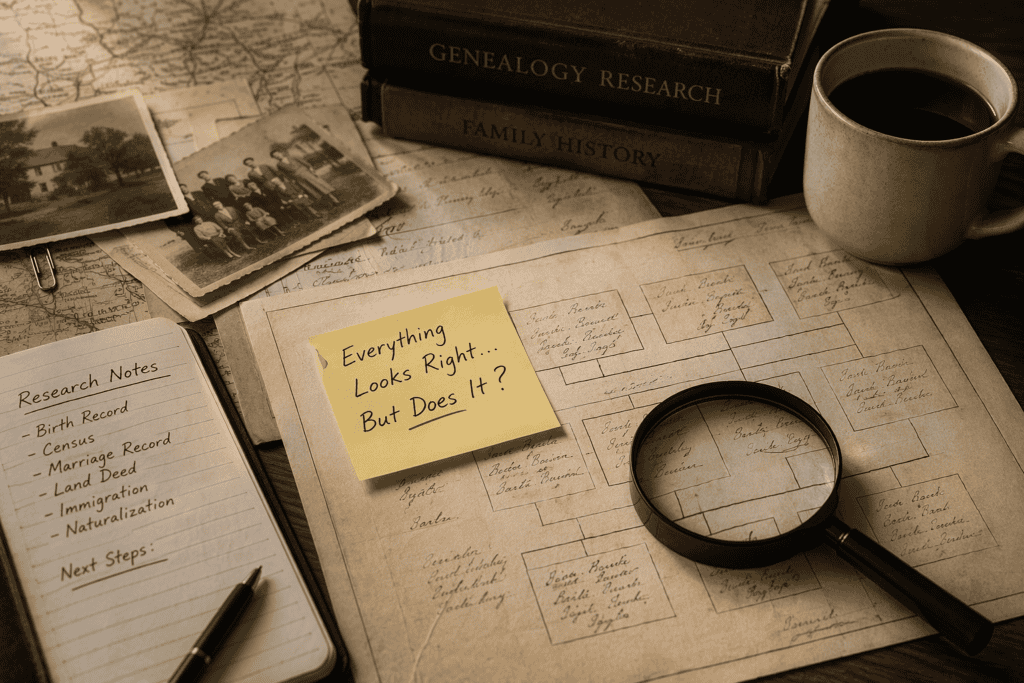
One of the most dangerous moments in genealogy research isn’t confusion.
It’s when everything appears to fit.
- Names align
- Dates make sense
- Locations seem consistent
And the search begins to feel complete.
Nothing is obviously wrong.
Which is exactly the problem.
Because a search can feel stable—
and still be wrong.
The Comfort of a Clean Fit
Most genealogy work naturally moves toward coherence.
- You gather records
- You organize timelines
- You resolve discrepancies
- You build a narrative that explains how the pieces connect
At a certain point, the search stops feeling like a question
and starts feeling like an answer.
That transition is subtle.
But it matters.
Because once a conclusion feels complete, the way you evaluate new information begins to change.
When Stability Replaces Scrutiny
In a stable search, new information is often interpreted through the existing conclusion.
- Records that align are accepted quickly
- Details that don’t quite fit are explained or minimized
- Gaps are treated as temporary, not structural
The search continues—but in a different mode.
Not investigation.
Confirmation.
And confirmation is efficient.
But it is not neutral.
The Role of Contradiction
Every accurate genealogy conclusion can withstand contradiction.
Not because it has no gaps—
but because it has been tested against them.
The problem is that contradiction doesn’t always appear clearly.
Sometimes it shows up as:
- A detail that doesn’t quite match
- A timeline that requires too much flexibility
- A relationship that works—but only if certain assumptions hold
- A DNA signal that doesn’t align cleanly with the documented line
Individually, these may seem manageable.
Collectively, they can point to something more fundamental:
The possibility that the current explanation is incomplete—or incorrect.
Why This Moment Is Easy to Miss
Stable searches create momentum.
- You’ve already invested time
- The structure makes sense
- The story holds together
So when a contradiction appears, the instinct is to absorb it—not challenge the structure itself.
This is especially true when:
- The contradiction is subtle
- The alternative is unclear
- The cost of being wrong feels high
So the search continues forward.
Even when it should pause.
The Real Turning Point
The most important shift in advanced genealogy research is not finding new evidence.
It is recognizing when the question itself needs to change.
Instead of asking:
“How do I extend this line?”
The question becomes:
“What if this line is not what I think it is?”
That is not a small adjustment.
It is a reorientation of the search.
What to Do When a Search Feels Too Clean
When a genealogy search begins to feel stable, it’s worth applying deliberate pressure.
- Identify the assumptions holding the conclusion together
- Look for evidence that would contradict the conclusion (not confirm it)
- Re-examine key relationships independently
- Bring DNA into the evaluation intentionally
This is where a search stops being about collecting records—
and becomes a process of evaluating competing explanations.
About the Author
Gary Katz is a professional genealogist and DNA detective specializing in Jewish and Eastern European family research, DNA analysis, and lineage reconstruction. He helps clients make sense of their ancestry and document their heritage.
If you’d like to follow along as I continue this work, I occasionally share notes and reflections in my
If you’re working through complex cases — especially those involving conflicting evidence or questions about how to interpret DNA results — the best place to begin is with a structured approach.
👉 Download the Genealogy Workflow Resource Guide
If you’re facing a difficult research question and want help clarifying what the evidence actually supports: