By Gary Katz
Professional Genealogist & Genetic Genealogy Analyst
If you’d like a structured way to approach genealogy research and evidence evaluation, you can download the Genealogist’s Workflow Guide here:
Download the Free Genealogist’s Workflow Guide
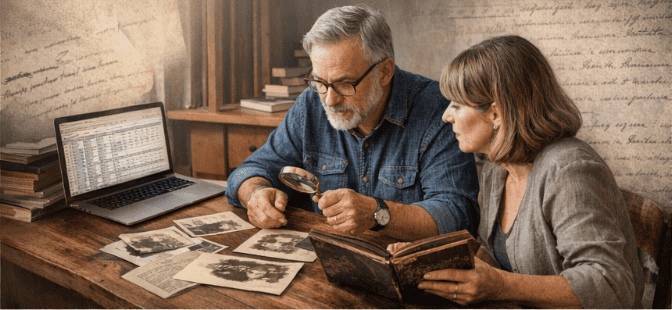
One of the most revealing moments in genealogy research comes when two sources point in different directions.
A family story suggests one version of events.
The records suggest another.
At first glance, it can feel like a contradiction.
In practice, it is often the beginning of deeper understanding.
Why This Happens So Often
Family history is passed down through memory.
Records are created at a moment in time.
Both are valuable. Neither is perfect.
Stories can preserve details that were never written down. They can also change subtly over time, shaped by retelling, interpretation, and sometimes omission.
Records, on the other hand, can contain errors, inconsistencies, or gaps. Names are misspelled. Ages shift. Relationships are recorded imperfectly.
When the two don’t align, it does not mean one must be discarded.
It means the research has reached a more interesting stage.
Start With the Timeline
When faced with conflicting information, one of the most effective first steps is to step back and reconstruct a clear timeline.
Lay out what each source is actually saying:
- dates
- locations
- relationships
- key events
Often, what initially appears to be a contradiction becomes more understandable when placed in sequence.
A story that seemed incorrect may turn out to refer to a different period, a different place, or even a different individual with a similar name.
Look for What Each Source Is Trying to Say
It can also help to ask a different question:
What is this source trying to communicate?
A family story may not be precise in its details, but it may capture something meaningful — a migration, a hardship, or a change in identity.
A record may be precise in form, but limited in context.
Understanding the role of each source helps prevent premature conclusions.
If you’d like a practical framework for evaluating evidence in genealogy, you can download the free reference guide here:
Get the Free Genealogist’s Workflow Guide
Accept That Uncertainty Is Part of the Process
One of the challenges in genealogy is the desire for clean, definitive answers.
In reality, some questions remain partially unresolved.
Two pieces of evidence may continue to point in different directions even after careful analysis.
In those cases, the goal is not to force a conclusion, but to document what is known, what is uncertain, and what remains to be explored.
When Stories Lead to New Records
Interestingly, apparent contradictions often point toward new research paths.
A detail in a family story — even one that seems questionable — can suggest:
- a location to investigate
- a surname variation
- a relationship worth exploring
In this way, stories and records do not compete with one another.
They inform each other.
Where This Fits in the Genealogist’s Workflow
In the Genealogist’s Workflow, this moment sits at the intersection of evidence and interpretation.
It is where research moves beyond collecting records and begins to involve analysis, comparison, and judgment.
Handled carefully, it is also where some of the most meaningful discoveries emerge.
About the Author
Gary Katz is a professional genealogist and DNA detective specializing in Jewish and Eastern European family research, DNA analysis, and lineage reconstruction. He helps clients make sense of their ancestry and document their heritage.
If you’d like to follow along as I continue this work, I occasionally share notes and reflections in my
Genealogy Gary Roots Roundup
.
If you’re facing a complex research question and want help clarifying what the evidence actually supports, the best place to begin is with a focused assessment.