By Gary Katz
Professional Genealogist & Genetic Genealogy Researcher
This article is part of my Evalu8 genealogy workflow — a flexible, objective-based system designed for the way real genealogy is actually done.
Evalu8 is not a linear checklist. Each objective can be entered, paused, revisited, or combined with others depending on the research question, available evidence, and moment of discovery.
Across the series, I’ve explored the Evalu8 workflow and its objectives through the following articles:
- Building the Tree Foundation: Turning Family Stories into a Solid Research Base
—Establishing a stable, well-documented starting point for all research
- Verifying the Family Chronicle: How to Turn Family Lore into Proven History
—Testing inherited stories against documentary evidence
- Surfacing Living Cousins: How to Find and Connect with Relatives Who Hold Missing Pieces of Your Family Story
—Identifying and engaging people who may hold unique knowledge or records
- Experimenting with Big Puzzles: How to Use Hypothetical Trees to Break Through Genealogical Brick Walls
—Using structured hypotheses without contaminating verified research
- Deep Diving into DNA: How to Turn Genetic Data into Ancestral Discovery
—Applying genetic evidence to confirm, refute, and extend documentary work
- Publishing for Posterity: How to Share and Preserve Your Family Research for Future Generations
—Ensuring that sound research survives beyond the active project
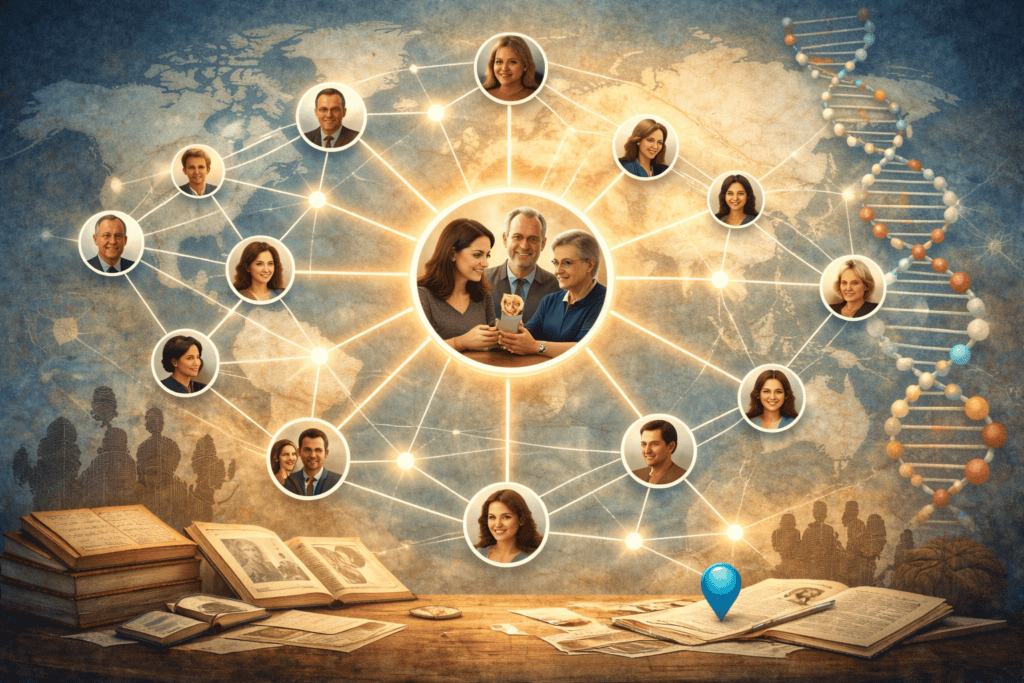
Connecting the Dots through Collaboration is the Evalu8 objective that turns individual research into shared discovery. While collaboration often becomes most visible after substantial solo work has been done, this objective can be activated at any point — early to gain access to records, midstream to test hypotheses, or later to confirm conclusions and enrich context.
In practice, collaboration is not a final step. It is a reusable research objective — one that accelerates progress whenever your work intersects with other people, overlapping questions, or shared ancestry.
The Myth of the Lone Genealogist
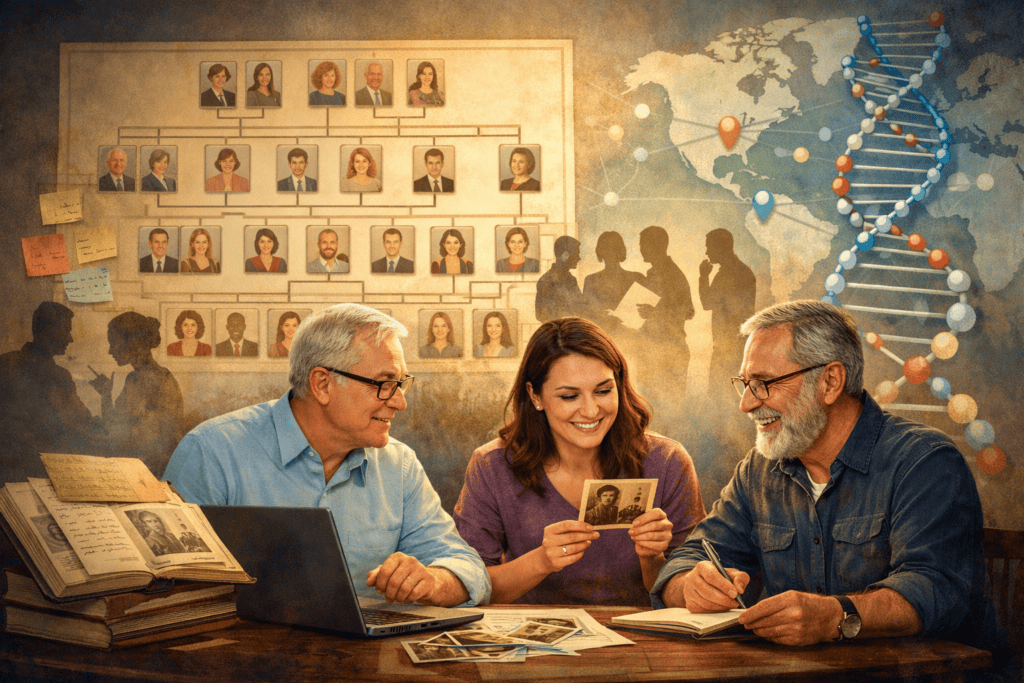
Genealogy often feels solitary — late nights with census records, DNA matches, and digitized parish registers. But no meaningful genealogical breakthrough happens entirely alone.
Behind almost every discovery is another human being: a cousin who shared a photograph, a researcher who indexed a town, or someone who asked the right question at the right time.
Every genealogist knows something you don’t. And you know something they don’t.
Clarifying the Collaboration Objective
Before reaching out, be clear about what collaboration can accomplish for your research.
- Verifying a shared ancestor
- Translating foreign-language records
- Understanding historical or community context
- Analyzing DNA segments or clusters
- Extending missing branches of a family
Collaboration doesn’t dilute your work. It multiplies it.
Finding Communities That Match Your Research
Modern genealogy is inherently networked. Nearly every place, population, and methodology now has a dedicated community.
- Regional and ethnic genealogical societies
- JewishGen SIGs and KehilaLinks
- DNA and genetic genealogy projects
- Collaborative tree platforms
- Local historical and archival groups
The most powerful tool in genealogy isn’t a database — it’s a shared question.
Establishing Credibility and Reciprocity
Strong collaboration begins with a clear, respectful introduction.
- Be specific about people, places, and evidence
- Distinguish confirmed facts from hypotheses
- Offer something of value in return
- Assume good faith and shared rigor
Collaboration thrives on generosity — and collapses on ego.
Working Within Structured Projects
Some of the most productive collaboration happens within organized efforts.
- FamilyTreeDNA surname or geographic projects
- Collaborative world-tree platforms
- Small research cooperatives
- Academic or archival partnerships
Structure turns individual effort into cumulative progress.
Documenting and Attributing Shared Work
Attribution is foundational to ethical collaboration.
- Credit contributors clearly
- Track sources jointly
- Use shared documents with version control
- Avoid overwriting others’ research
Shared data without sourcing creates shared confusion.
Navigating Collaboration Challenges
Disagreements are inevitable. Stalemates are optional.
- Anchor discussion in evidence
- Keep hypotheses labeled
- Allow parallel interpretations when needed
The Collaborative Genealogist’s Mindset
Collaboration isn’t about losing control. It’s about gaining perspective.
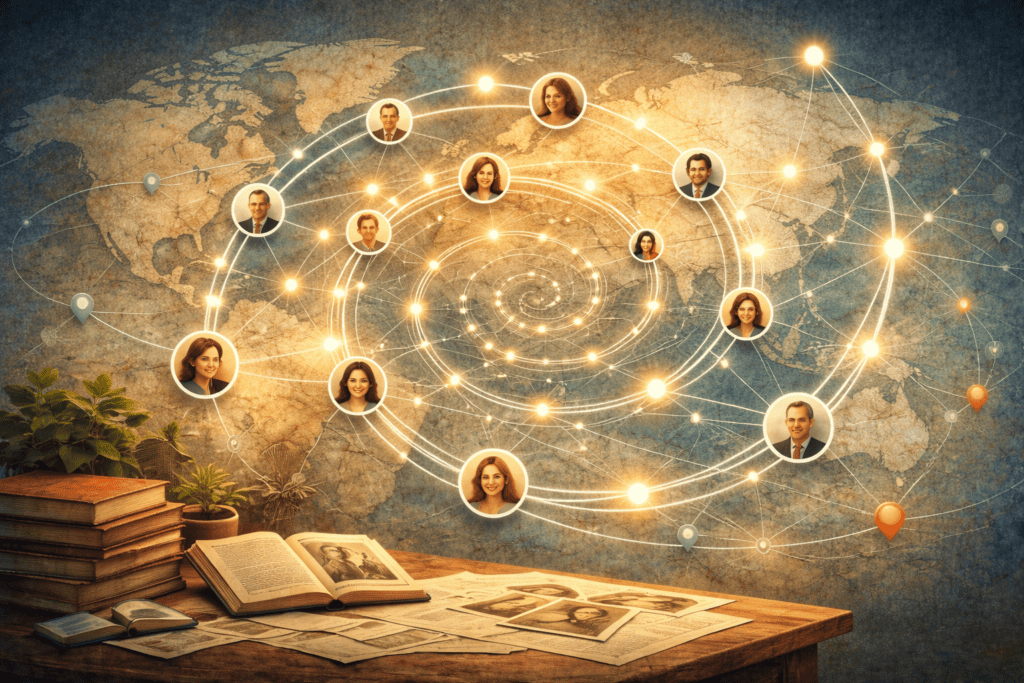
When genealogists pool their knowledge, individual trees stop being islands and become networks — connected across time, geography, and shared curiosity.
Next in the Workflow
Hunting for Random Nuggets is the final Evalu8 objective. It keeps the research ecosystem open — allowing weak signals, side clues, and chance discoveries to re-enter the workflow wherever they prove useful.
About the Author
Gary Katz is a professional genealogist and DNA detective specializing in Jewish and Eastern European family research, DNA analysis, and lineage reconstruction. He helps clients make sense of their ancestry and document their heritage.
If you’d like to follow along as I continue this work, I occasionally share notes and reflections in my
Genealogy Gary Roots Roundup
.
If you’re facing a complex research question and want help clarifying what the evidence actually supports, the best place to begin is with a focused assessment.
2 Comments