
By Gary Katz
Professional Genealogist & Genetic Genealogy Analyst
Every genealogy journey begins long before a record search or DNA test — it begins with stories. Fragments of memory, family lore, and half-remembered details form the raw material of nearly every research project I take on.
In the first article of this series, I introduced the professional genealogy workflow and explained why a structured process is essential for turning family mysteries into documented conclusions. This article moves from theory into practice by focusing on the very first hands-on step: building a stable foundation tree that can support every record search, DNA analysis, and conclusion that follows.
If you’re new to the series, I recommend starting with
Article 1: The Genealogist’s Workflow
,
which outlines the full research process from initial questions to evidence-based results.
In this article, you’ll learn how to:
- Turn family stories into a structured research foundation
- Capture oral history before record searches and DNA analysis
- Choose effective tools for building a reliable family tree
- Organize, cite, and evaluate your work like a professional genealogist
Every Great Genealogy Project Begins with a Story
Nearly every client project I take on starts the same way: with a conversation that begins, “My grandfather used to tell this story…”
Family history often lives in fragments — in stories told around a dinner table, old photos in a shoebox, or handwritten notes on the back of a postcard. Before a single record search or DNA test, the first step of professional genealogy is to capture those fragments and begin shaping them into a structured, sourced family tree.
This is what I call Building the Tree Foundation — the essential first objective in my professional genealogy workflow.
The goal isn’t perfection or completeness. It’s stability — a reliable framework that will hold up as new discoveries and DNA evidence come in.
Why the Foundation Matters
Your family tree isn’t just a chart — it’s a working hypothesis. Every name, date, and connection represents an assertion that can (and should) be tested.
Without a well-organized starting tree, you’ll quickly find yourself lost in circular searches, duplicate records, or mislinked families — common traps for even experienced researchers.
- A reference map for every research question you ask later
- A shared framework you can publish or collaborate on
- A verification baseline for evaluating DNA matches
Think of it as the scaffolding that lets the rest of your genealogical research stand tall and stable.
Step 1: Start with the Living — and Listen Deeply

Your most valuable sources aren’t in archives; they’re sitting at family tables.
Start by interviewing the oldest known relatives. Let them speak freely — and don’t worry about verifying or correcting their recollections yet. You’re capturing raw data, emotional context, and clues.
- “Who do you remember most from your childhood?”
- “Did anyone in the family come from another country?”
- “Are there old family photos, letters, or documents you’ve kept?”
Then, expand your scope to include branch genealogists — cousins or relatives who’ve already started their own trees on Ancestry, MyHeritage, or FamilySearch.
Step 2: Choose Your Tree-Building Platform Wisely
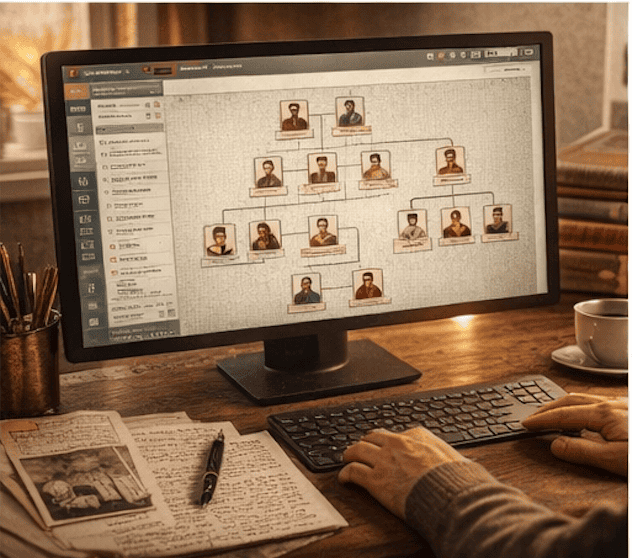
Once you have names, stories, and family clusters, the next step is to build your initial tree digitally. Following are some best-in-class genealogy tools to consider:
| Platform Type | Examples | Best For |
|---|---|---|
Online Genealogy Sites | Ancestry, FamilySearch, | Collaboration and cousin discovery |
Desktop Software | Family Tree Maker, RootsMagic, | Data control and professional citation |
Step 3: Build Outward from Yourself — Carefully
This step establishes accuracy and prevents errors from compounding as your tree grows.
Start with yourself, then move outward generation by generation. Add only what you know with confidence, and mark unverified information clearly.
- Record full names and spelling variants
- Include locations for life events
- Use approximate dates when needed
- Maintain consistent place naming
Step 4: Organize, Cite, and Sync

Every fact should have a source. Even simple citations provide crucial provenance and future-proof your research.
Step 5: Enrich the Tree with Context and Media

Photos, letters, certificates, and audio recordings add depth and meaning to your tree.
Step 6: Collaborate Early and Transparently
Collaboration works best when expectations and evidence are clearly defined from the start.
Share your work early, label hypotheses clearly, and invite collaboration.
Step 7: Step Back — and Evaluate Your Foundation
This is where you shift from building to critical evaluation.
You’re not aiming for perfection — just a foundation strong enough to support confident future research.
Building a Tree Is Like Framing a Story
When you build your foundation tree, you’re framing a narrative that will guide every future discovery.
Next in the Geneology Workflow:
Article 3: Verifying the Family Chronicle — How to Turn Family Lore into Proven History
About the Author
Gary Katz is a professional genealogist and DNA detective specializing in Jewish and Eastern European family research, DNA analysis, and lineage reconstruction. He helps clients make sense of their ancestry and document their heritage.
If you’d like to follow along as I continue this work, I occasionally share notes and reflections in my
Genealogy Gary Roots Roundup
.
If you’re facing a complex research question and want help clarifying what the evidence actually supports, the best place to begin is with a focused assessment.
9 Comments